
Journal
22 Momme Silk Explained: Why It Became the Standard
May 6, 2026
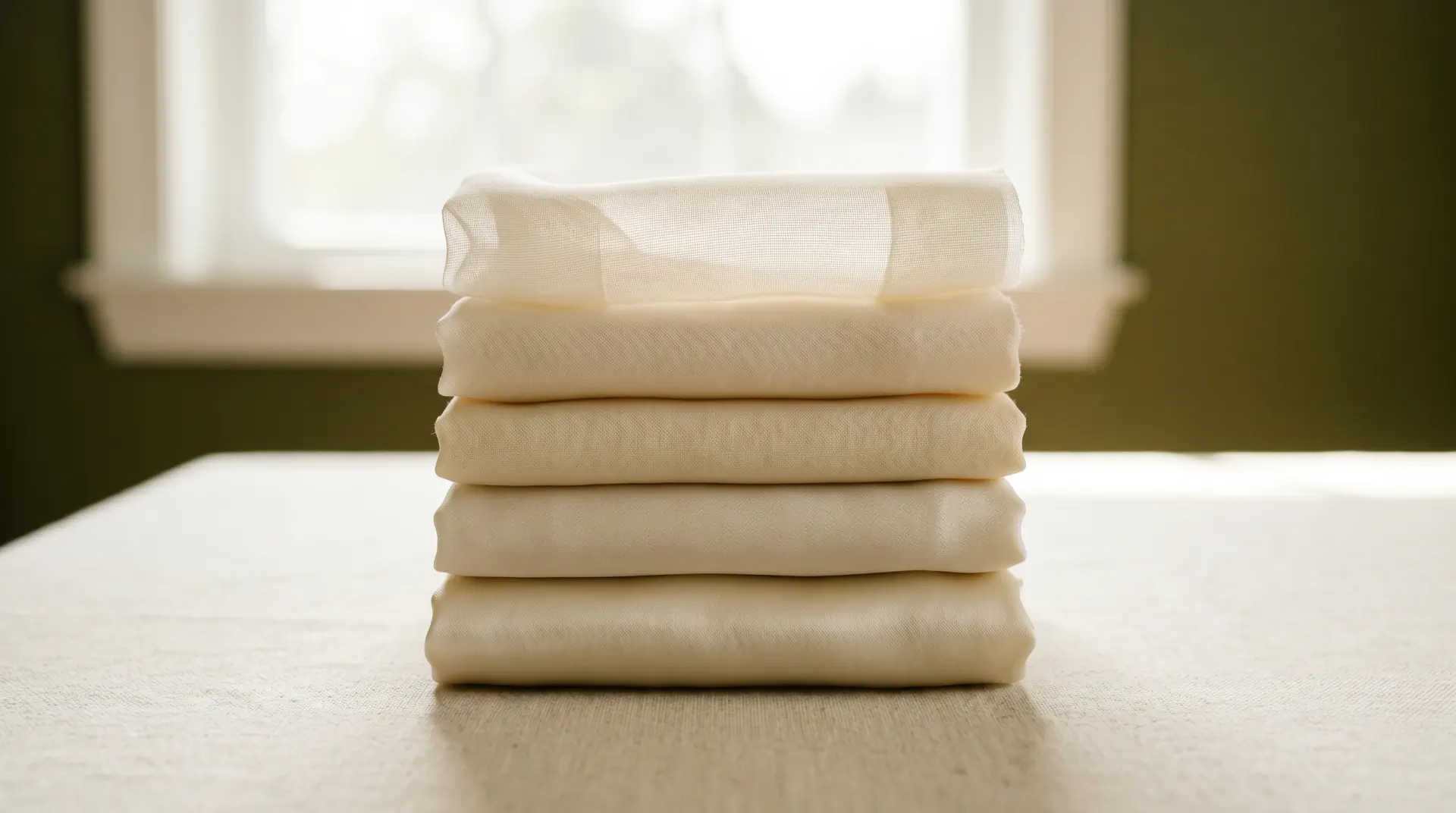
If you have shopped for a silk pillowcase, bonnet, or eye mask, you have run into the number "22 momme." It appears on product pages, marketing copy, and review listicles with such consistency it feels like an industry rule. It is not. Momme is a real, measurable property of woven silk, but "22 momme is correct for every silk product" is a marketing convention, not a textile law. The honest framing: 22 momme is the best balance of durability, drape, and cost for everyday skin-contact silk — pillowcases, bonnets, and eye masks. Lighter silk (16-19 momme) is acceptable and more affordable. Heavier silk (25 momme and up) is luxurious but not necessarily better for the way most people use these products. This post explains what momme actually measures, why 22 settled into the standard slot, how it compares to its neighbours, and how to verify the number before you pay for it. For the deeper interactive comparison, see our pillar Silk Momme Weight Guide.
What momme weight actually means
Momme (pronounced "mummy") is a traditional Japanese weight-per-area measurement codified into international silk trade practice. One momme is the weight in pounds of a silk piece 100 yards long and 45 inches wide — roughly 4.33 grams per square metre. So 22 momme silk weighs approximately 95 g/m², heavier than 16 momme (about 69 g/m²) and lighter than 25 momme (about 108 g/m²).
Momme is a density measure. It tells you how much silk is packed into a given area, which affects opacity, hand-feel, drape, and durability. It does not tell you anything about fibre quality. A 22-momme polyester satin and a 22-momme 6A mulberry silk are completely different fabrics, even though their weights match. When shopping, look for momme weight and a fibre statement (mulberry silk, charmeuse weave) and a grade (6A) — not momme alone.
What momme is not: an ISO or ASTM standard. It is not peer-reviewed. No academic paper defines the unit. Momme is a trade-practice convention the industry agrees on — its authority comes from consistent use across silk mills, not from a textile-science statute.
Why 22 momme became the silk pillowcase standard
If momme has no formal regulation, why has 22 become ubiquitous on pillowcase listings? It sits at the sweet spot of a three-way tradeoff:
- Durability: Silk in the 19-22 momme range survives nightly use and weekly cold-water washing for several years without thinning. Silks below 16 momme are noticeably more fragile under repeated laundering — fine for scarves, problematic for pillowcases.
- Drape and breathability: At 22 momme, the fabric is opaque and substantial but still drapes naturally and breathes well — important for a pillowcase your face presses against for eight hours. At 25-30 momme the fabric starts to feel heavier and slightly stiffer; at 12-16 momme it can feel too thin.
- Cost: Silk is sold by weight, so heavier silk costs more per square metre at the mill. A 22-momme pillowcase is roughly 15-20% more expensive than a 19-momme one, and a 25-momme pillowcase is another 20-30% above that. The improvement from 19 to 22 is meaningful; from 22 to 25 is marginal.
That convergence — across mills like Mayfairsilk, Mulberry Park Silks, Slip, and Lilysilk — is why "22 momme mulberry silk" became shorthand for "premium silk pillowcase" without any standards body decreeing it should.
How 22 momme compares: 19mm vs 22mm vs 25mm side-by-side
Here is how the three weights stack up for skin-contact silk products, drawing on industry-reference framing rather than peer-reviewed data:
| Property | 19 momme | 22 momme | 25 momme |
|---|---|---|---|
| Weight (g/m²) | ~82 | ~95 | ~108 |
| Hand-feel | Smooth, slightly thinner | Smooth, substantial | Smooth, dense |
| Opacity | Good | Excellent | Excellent |
| Drape | Fluid | Balanced | Slightly stiffer |
| Best for | Budget pillowcases, summer sleepers | Daily-use pillowcases, bonnets, eye masks | Luxury bedding, gift items |
| Typical price (Queen pillowcase) | $40-70 | $60-150 | $130-240 |
| Lifespan with proper care | 3-5 years | 5-7+ years | 5-8+ years |
25 momme is not "better" in any absolute sense — it is heavier, more expensive, and somewhat stiffer. Heavier silk is genuinely better for items where substrate matters: blankets, robes, dressing-gown linings. For a pillowcase, the performance gap between 22 and 25 is small, and many sleepers find 22 more comfortable because it is lighter on the face. For silk eye masks and scrunchies, the standard is 19-22 momme — going above 22 on a sleep mask makes it feel bulky without a meaningful benefit.
Hair benefits: friction, breakage, manageability
Here we have to be careful and honest. The most-quoted statistics in silk marketing ("43% less hair breakage", "34% lower friction") come from in-house lab tests by silk-pillowcase brands, not from peer-reviewed research. We will not repeat them as independent science. What we can cite is the underlying mechanism.
In her peer-reviewed review of hair cosmetics, Dias 2015 writes that "abrasion and friction are important factors that cause hair damage by protein loss." That is the academic anchor: friction against rougher fibres damages the hair cuticle over time, leading to breakage, split ends, and frizz. Silk has a smoother fibre surface than cotton, so a silk pillowcase or bonnet creates a lower-friction sleeping surface.
What the science does not yet establish is a precise percentage difference between silk and cotton pillowcases for human hair breakage — no peer-reviewed RCT has measured it. What it does support is that lower friction is mechanistically beneficial. For curly, coily, color-treated, or chemically processed hair, the cumulative reduction in nightly friction matters, which is why silk bonnets are a staple of textured-hair night routines. See the best silk bonnets for 2026 for picks at 22 momme and above, or browse the silk bonnet collection directly.
So the honest framing on hair: 22 momme silk gives you the smoothest, most consistent low-friction surface mass-market silk offers; the mechanism is established; the specific percentages are brand-lab numbers.
Skin benefits: moisture retention, contact comfort
Silk's protein fibres absorb less ambient moisture than cotton (cotton is hygroscopic), so a silk pillowcase pulls less of the skin's night-time moisture into the fabric. For sleepers who use night creams, hyaluronic-acid serums, or facial oils, this matters: cotton can wick those products off the skin before they absorb.
Research on the silk protein sericin reinforces this. Padamwar et al. (2005, Journal of Cosmetic Dermatology) showed in human in-vivo tests that sericin restores amino acids and creates an occlusive effect that reduces water loss and improves skin-surface smoothness. That study was on topical sericin, not a pillowcase, so we cannot transfer the percentages — but it establishes that silk proteins themselves have measurable moisturizing properties.
At 22 momme, silk has a smooth, cool-touch surface that adapts gently to skin temperature. Heavier silk (25mm+) traps slightly more body heat against the face — winter-pleasant, summer-uncomfortable. Lighter silk (16-19mm) feels cool but shifts more during the night. The 22 momme middle is the most use-case-flexible.
General principle: silk is a supportive fabric for skin care, not a treatment. It does not cause acne, treat eczema, or fix wrinkles on its own. What it does is reduce friction, retain skin moisture, and stay cleaner between washes than cotton — three small advantages that compound over years of nightly use.
Buyer's checklist: 6A grade + 22 momme + finished edges
Momme alone does not guarantee a quality product. A complete spec should hit at least these six points:
- Fibre: 100% mulberry silk (not "silk satin", which is often polyester). ISO 2076:2021 reserves "silk" for protein silk fibre.
- Grade: 6A — the highest grade for mulberry silk, indicating long, uniform fibres with natural lustre.
- Momme: 22 for pillowcases and bonnets; 19-22 for eye masks; 16-19 for lighter scarves.
- Weave: charmeuse (smooth, low-friction face). Avoid habotai for skin-contact products — too thin.
- Edge finish: French seams, hidden zippers, or rolled hems — not raw or fraying edges.
- documentation: [fabric and finish documentation](https://www.fabric and finish documentation.com/en/our-standards/fabric and finish documentation-standard-100), indicating the silk has been tested against more than 1,000 unwanted finish residues.
If a product page states "22 momme" without naming the silk type, the grade, or showing documentation, treat it as a yellow flag. Many polyester-satin pillowcases are sold using "momme" as if it applied to them — it does not. Momme is a silk-specific measurement.
Frequently Asked Questions
Is 22 momme the same as 22mm? Yes — "mm" in silk listings is shorthand for momme, not millimetres. The notation "22mm silk" means 22 momme, not 22-millimetre-thick fabric.
Why do most silk pillowcases use 22 momme? Because 22 momme is the most cost-effective weight that delivers full opacity, all-night durability, and balanced drape. Lighter silks wear faster; heavier silks cost significantly more for marginal gains. The industry converged on 22 because it is the point where the marginal benefit per dollar drops sharply.
Is 25 momme better than 22 momme? Not for everyday pillowcases, bonnets, or eye masks. 25 momme is genuinely better for blankets, robes, and bedding where heft matters. For face-and-hair-contact accessories, the practical difference is small, the price difference is significant, and many sleepers prefer the lighter, cooler feel of 22 momme.
Will 22 momme silk last 5 years? Yes, with proper care: cold water, pH-neutral silk wash, mesh laundry bag, no bleach, no tumble dry, air-dry in shade. Most 22 momme 6A mulberry silk pillowcases last 5-7 years of nightly use. Aggressive washing (hot water, regular detergent, dryer) can cut that to 1-2 years.
How do I verify the momme weight on a product? Look for an explicit number on the product page, ideally backed by a fibre statement ("100% 22-momme 6A grade mulberry silk"). Reputable brands publish this; vague "luxury silk" descriptions usually do not. With a kitchen scale, you can weigh and back-calculate — a queen pillowcase (about 0.6 m²) at 22 momme weighs roughly 57 grams.
Shop verified 22-momme silk
Every Muriersilk skin-contact product — silk bonnets, silk eye masks, pillowcases, and scrunchies — is woven from 22-momme 6A grade mulberry silk and quality-checked. We picked 22 because it is the weight that respects both your hair and your wallet. For the deeper interactive comparison across all weights from 6 to 25 momme, see the Silk Momme Weight Guide.
General textile guidance only. Comfort varies by person and product; no fabric guarantees a sleep or medical outcome.