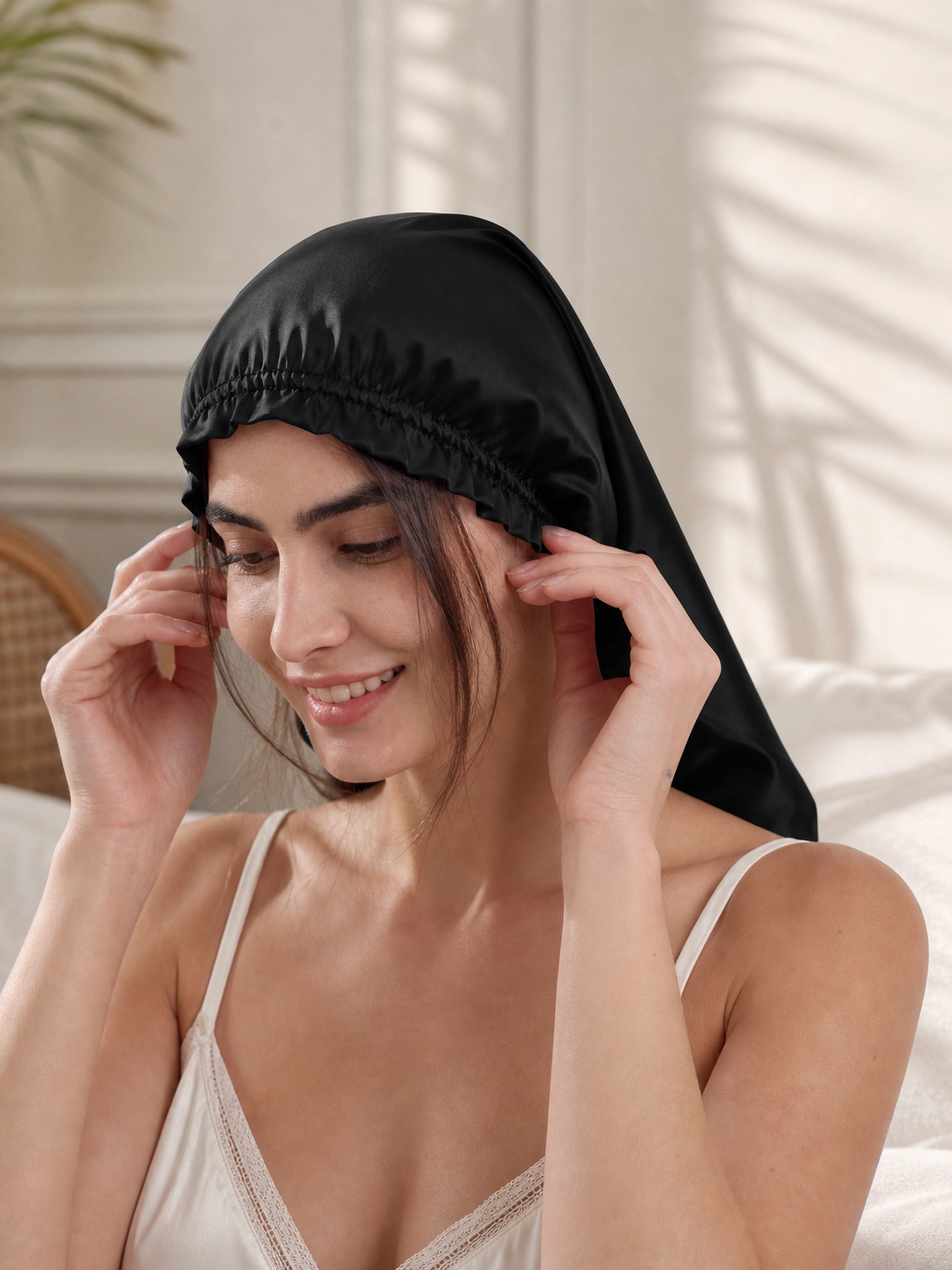

How to Choose a Silk Bonnet Band Without Guessing

A silk bonnet band is easy to overlook until it does not feel right. If it slips, pinches, leaves you adjusting it at midnight, or feels distracting when you lie down, the rest of the routine becomes harder than it needs to be. Choosing well is less about finding one “correct” band and more about checking the fit against the way you actually sleep and wear your hair.
Start with comfort and stability together. A band that is very tight may seem secure while you are standing up, but it can feel uncomfortable after an hour in bed. A band that is very loose may feel pleasant at first but shift when you turn over. The useful middle ground is a bonnet that sits in place with the smallest amount of tension needed for your own routine.
There is no universal size or adjustment that suits every head shape, hairstyle, or sleep position. Use a practical fitting process, take notice of how the bonnet behaves overnight, and make one small change at a time. That will tell you more than trying to solve every possible concern before the first wear.
Start with the hair you will actually sleep in
Before judging a band, prepare your hair in the way you usually do at bedtime. Hair gathered into a loose braid, a bun, twists, loose curls, or a straight style can all create different amounts of volume and change where a bonnet sits. Trying on a bonnet over a completely different hairstyle can make the fit test misleading.
Avoid placing a hard clip, pin, or bulky tie where the band will rest. These can create pressure points and make a comfortable band seem like the problem. If you use a hair tie, choose a placement that does not force the bonnet up at the back or make the front edge ride higher than you want.
Then place the bonnet in its intended position and smooth the band gently around the head. It should not need to be pulled far down over the forehead or stretched low around the neck to feel stable. If it does, pause before tightening anything further and reassess the overall fit.
Use the smallest effective adjustment
An adjustable silk bonnet can be useful because it lets you make small fit changes. The key word is small. Adjust only until the band feels secure, then test it by moving your head and lying in your usual sleep position. More tension is not automatically a better fit.
If the band has an adjustment point, keep it in a place that will not press against the pillow. Check whether the adjustment creates a knot, seam, or gathered area where you usually lie on your side or back. Repositioning that one detail can be more effective than tightening the band.
After you lie down, take a slow breath and notice whether you feel tempted to keep touching the band. A well-set band should fade into the background. If you can feel it constantly, it may be too tight, sitting at an awkward angle, or competing with the way your hair is arranged.
Test stability without forcing it
Turn your head from side to side while lying down. Sit up, lean back, and gently roll onto the positions in which you normally sleep. A bonnet may move a little during those tests; the goal is not to make it immovable. The question is whether it stays reasonably placed without discomfort or repeated readjustment.
Do not use pins, tape, or improvised fasteners to force a band into place. Those additions can be uncomfortable in bed and make it harder to identify the real fit issue. If a bonnet will not stay comfortable after ordinary adjustment, a different style or fit may be more sensible than an increasingly elaborate workaround.
Learn the signals of a too-tight band
Shop the Collection
Shop our silk bonnets
Ruffled Reversible Silk Bonnet - 'SilkRuffle'Free shipping over $150
A silk bonnet band is probably too tight if you notice persistent pressure, a headache-like feeling, sharp lines that remain uncomfortable, or an urge to remove it soon after getting into bed. Those signals are worth taking seriously. The purpose of a bedtime accessory is not to turn sleep into a tolerance test.
First, loosen the adjustment if there is one. Next, change the position slightly and make sure hair underneath is not pushing the band outward. If it still feels tight, stop trying to make the same setting work. A fit that requires constant negotiation is not a relaxed part of a night routine.
It can help to try the bonnet earlier in the evening for a short period, when you are awake enough to notice where pressure starts. This does not replace an overnight test, but it can prevent you from making a major adjustment after you are already tired.
Learn the signals of a too-loose band
The opposite problem is a band that keeps creeping upward, turning around the head, or coming off while you sleep. Check the placement before assuming the band is the only cause. Hair gathered into a high, uneven shape can push against the fabric. A very smooth hairstyle may also make a different arrangement feel more stable than a single tight setting would.
Try placing the bonnet so the band lies flat and the fabric is distributed evenly around your hair. If it has an adjustable element, make one small change and test again. Do not jump from loose to very tight in one move. Small adjustments make it easier to recognise the point at which stability improves without comfort dropping away.
If the band still slips after a few ordinary trials, the problem may be the style’s overall shape for your needs. That is useful information, not a reason to keep forcing an unsuitable fit.
Think of sizing as a process, not a number
A bonnet sizing guide can be a useful starting point, but it cannot fully predict how a bonnet will feel once your hair and sleep habits are part of the equation. Your most helpful measurements are lived ones: whether the band stays flat, whether it feels secure after you change position, and whether it remains comfortable until morning.
If you are comparing styles, look for the fit information the product provides and consider the hair volume you commonly sleep with, not only your hair length. A long style worn loose can behave differently from the same hair gathered close to the head. Braids, protective styles, and fuller curl patterns may call for a different interior shape or volume allowance than a close-to-the-head style.
Do not assume that a smaller band is automatically more secure or that a larger one is automatically more comfortable. The right choice is the one that accommodates your normal arrangement without pulling or repeatedly shifting.
Care affects comfort too
Residue, a twisted band, or a damp bonnet can make fit feel worse than it is. Between uses, let the bonnet air in a clean, dry location and inspect it for product transfer or a lingering scent. When it needs cleaning, follow the care label for that specific item. Do not rely on a generic washing rule based only on the words silk or satin; silk is a fibre and satin is a weave.
When drying or storing the bonnet, avoid stretching the band around a hook or tightly rolling it with other items. Let it rest in shape. A small morning reset—straightening the band and storing it dry—can make the next fitting easier.
A low-stress fitting checklist
Use this sequence the first few times you wear a new bonnet:
- Arrange hair as you normally would for sleep.
- Place the bonnet so the band lies flat, without pulling it low or tight.
- Make the smallest adjustment that feels stable.
- Lie in your common sleep positions for a minute.
- Remove or reposition anything that creates a pressure point.
- In the morning, decide whether to loosen, tighten slightly, or leave the setting alone.
That is enough. You do not need to keep changing the setting throughout the night to find a useful fit.
Frequently Asked Questions
Tight enough to stay reasonably in place, but not so tight that it creates pressure or distracts you from sleep.
The band may be too tight, positioned awkwardly, or resting over bulky hair or a closure. Loosen it and recheck the hair arrangement.
It is better to reassess the fit or style. Pins and improvised fasteners can be uncomfortable in bed.
Possibly. Recheck the fit whenever your overnight hair arrangement changes. Browse the [Muriersilk silk bonnet collection](/categories/silk-bonnet) when you are choosing a style to test against your own sleep routine.
Shop the Collection
Shop our silk bonnets
Free shipping over $150