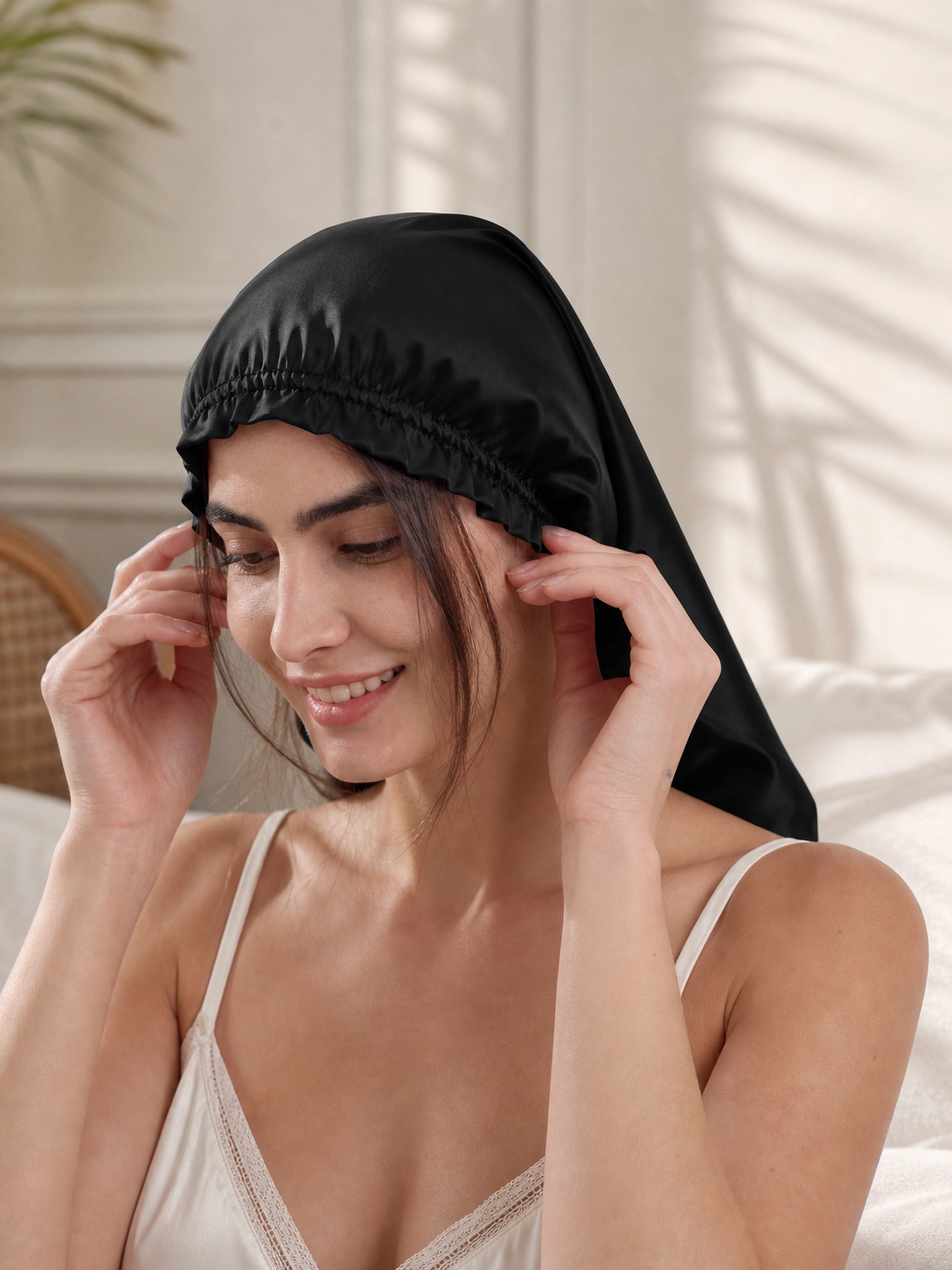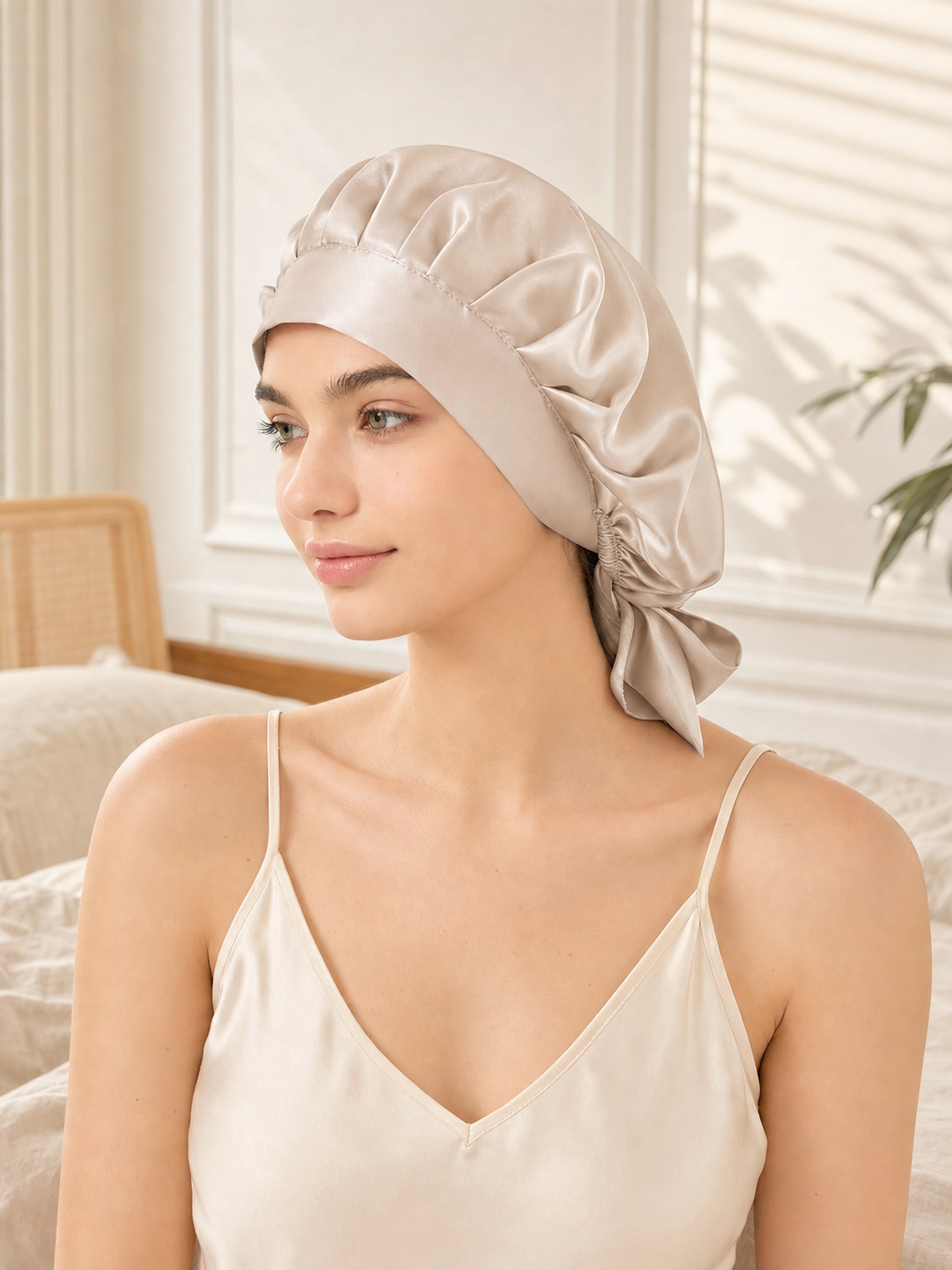

Can You Use a Silk Bonnet and Silk Pillowcase Together?

A silk bonnet and silk pillowcase can sit in the same night routine. You do not need to treat them as competing choices, and you do not need a complicated set of rules to use both. The useful question is what makes bedtime feel comfortable and manageable for you: how you wear your hair, whether your bonnet stays in place, how often you want to wash sleep accessories, and what you are likely to keep doing consistently.
One item covers your hair while you sleep; the other covers the pillow. That difference gives each a separate job in a routine, even when they are used on the same night. Some people prefer a bonnet as the main part of their routine and see the pillowcase as a simple backup surface. Others choose a pillowcase on nights when they do not want something around their head. Using both is simply another option.
The details matter more than a universal answer. Start with a setup that feels comfortable, check the care labels for the items you own, and adjust one variable at a time. A routine that you can put on and take off without fuss is usually easier to sustain than one built around a long list of rules.
What each item changes at bedtime
A bonnet stays with your hair as you move. That can be useful if you prefer to keep your hair gathered, contained, or covered during the night. A pillowcase stays on the pillow. It is there whether you sleep on your back, side, or stomach, and it does not require any fit adjustment before you get into bed.
That is why the choice is not always bonnet or pillowcase. A person who likes the feeling of a bonnet may still appreciate having a pillowcase that fits the rest of the sleep environment. Someone who does not want to wear a bonnet every night may use a pillowcase as the simpler part of the routine. The combination is not a promise about a specific hair or skin result. It is a practical way to decide what surfaces and accessories feel right for your own bedtime habits.
A simple way to use both
The most direct setup is also the least fussy: put the pillowcase on the bed, prepare your hair as usual, and put on the bonnet only if you want to wear it. There is no special order beyond that. The pillowcase does not need to be adjusted around the bonnet, and the bonnet does not need to be tied more tightly because the pillowcase is in use.
Before bed, make a quick comfort check. Your hair should be arranged in a way that does not pull. The bonnet should feel secure enough to stay on without creating a distracting pressure point. If it has an adjustable element, use the smallest adjustment that feels stable rather than tightening it until it is uncomfortable. Then lie down for a minute. If you notice a seam, knot, or gathered section pressing where you usually sleep, reposition it while you are still awake.
The next morning, notice the parts that affect whether you will repeat the routine. Did the bonnet remain comfortable? Did it shift? Was it easy to remove? Did either item feel damp after a warm night? These observations are more helpful than deciding that one combination must work for everyone.
Keep hair preparation ordinary
You do not need a separate hair ritual in order to use a silk bonnet and silk pillowcase. Use the products and styling approach that suit you, then consider whether anything is still very wet, heavily coated, or likely to transfer before you cover it. Letting products settle when practical can make the setup feel fresher and reduce the need to inspect accessories immediately the next day.
This is also a good reason to separate regular nights from occasional high-product nights. If you use more oil, cream, or styling product than usual, check the inside of the bonnet and the pillowcase in good light the next morning. Follow the specific care label if either item needs cleaning. Do not assume that a generic care method applies to every silk item.
Fit matters more than extra steps
Shop the Collection
Shop our silk bonnets
Ruffled Reversible Silk Bonnet - 'SilkRuffle'Free shipping over $150
If the bonnet slides off, the issue is usually worth solving before adding more products or accessories. Start by checking whether hair is placed in a way that creates an uneven bulk, whether the band is sitting over a smooth section, and whether the closure is adjusted only as much as needed. A bonnet that feels stable while you are sitting up may move differently once you lie down, so test it in your usual sleep position.
Avoid using pins, clips, or improvised fasteners against the head just to force a bonnet to stay in place. They can be uncomfortable in bed and can complicate a simple routine. If the fit still does not work after a few calm adjustments, it may be more useful to reassess the style or fit than to keep tightening the same band.
The pillowcase needs a fit check too, although it is more basic. It should sit securely on the pillow and be clean and dry before use. A loose, bunching pillowcase can make bedtime feel untidy regardless of what you wear on your hair.
Care both items without overdoing it
Care labels are the authority for the exact items you own. Silk is a fibre, while satin is a weave, so words used in a product description are not enough to determine the right washing or drying method. Check the label before deciding whether to hand wash, machine wash, dry flat, or use another method.
Between washes, let the bonnet air out in a clean, dry place rather than putting it immediately into a closed bag or under a pillow. Check it for product transfer, scent, or dampness. Treat the pillowcase similarly: change or clean it according to its label and the way it is used in your routine. If you use both, they do not have to be washed on exactly the same day. Clean each when its condition and care guidance call for it.
Keep them away from direct heat and from open cosmetics or hair tools when storing them. Those simple habits reduce the chance that you will need to deal with a spill or residue later.
Where the combination can be useful
Using both can make sense when you want choices within the same routine. Perhaps you wear a bonnet most nights but want a familiar pillow surface when the bonnet shifts. Perhaps you share a bed and want a setup that does not require a particular sleep position. Or perhaps you simply prefer to use a bonnet for some hairstyles and a pillowcase for others.
It can also be useful for travel. A bonnet takes up little space in a bag, while a pillowcase may be a familiar item to bring when sleeping away from home. Pack only items that are clean and fully dry, and give them a chance to air out after travel before returning them to regular storage.
Build a routine you will actually keep
For a silk sleep routine, start with the smallest repeatable version: clean hair or a comfortable style, a dry pillowcase, and a bonnet only when you want one. Keep the items in the same place so you do not have to search for them at bedtime. Leave a little space for airing the bonnet between uses. Check labels before cleaning rather than relying on a broad online rule.
After a week or two, make only one adjustment if something is not working. Change the way you gather your hair, alter the bonnet fit, or choose to use the pillowcase alone on some nights. Small changes make it easier to understand what actually improves your own experience.
Frequently Asked Questions
Yes. A silk bonnet and silk pillowcase can be used together if the setup is comfortable and the items are clean and dry.
No. Many routines use one or the other. Use both only if the combination suits your habits.
Not necessarily. If a bonnet shifts, check its fit, hair placement, and comfort in your usual sleep position.
Not automatically. Inspect each item and follow its individual care label. Explore the [Muriersilk silk bonnet collection](/categories/silk-bonnet) if you are building a night routine around a bonnet that feels right for you.
Shop the Collection
Shop our silk bonnets
Free shipping over $150