
Journal
Silk Bonnet for Thinning Hair, Chemo & Sensitive Scalp — A Caregiver's Guide
May 9, 2026

Author: The Muriersilk Editorial Team
Last reviewed: May 9, 2026
Sources: Findings from this article draw on publicly available research from the American Academy of Dermatology, PubMed (NCBI), and ISO 2076:2021 textile-fiber standards. See citations throughout the article.
For personal medical concerns related to hair loss, scalp sensitivity, or chemotherapy-related care, please consult a licensed healthcare provider. This article is informational and is not medical advice.
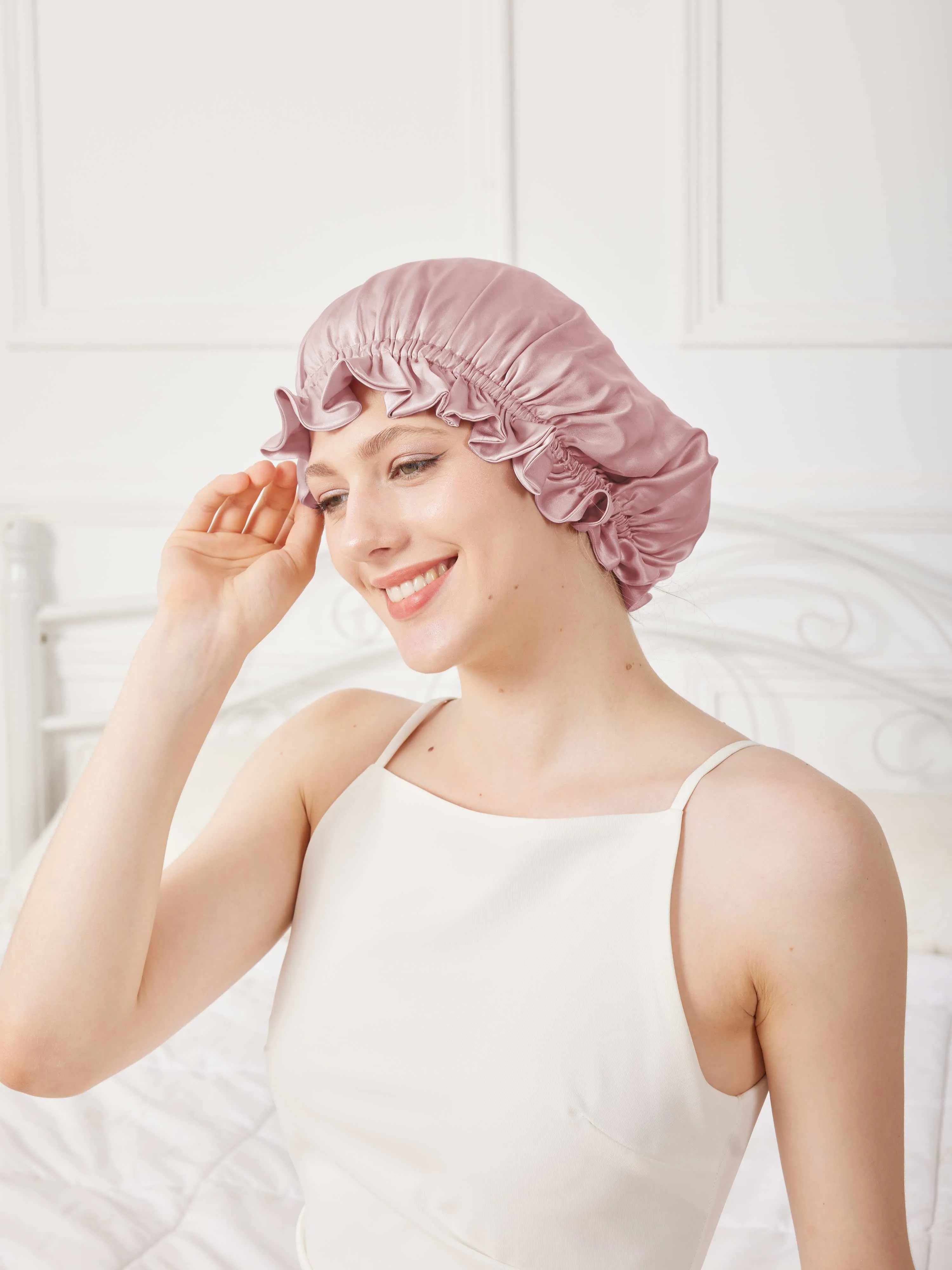
For someone going through chemotherapy, alopecia, or any condition that leaves the scalp and remaining hair more fragile than usual, a bonnet is not a beauty accessory. It is a comfort layer — something that sits softly against the skin for 6–8 hours at night, holds in warmth, and minimizes the small mechanical stresses that healthy hair shrugs off but fragile hair does not.
This guide is written for caregivers, family members, and patients themselves who are looking at silk bonnets and asking practical questions: What features matter when the scalp is sensitive? What should be avoided? How do you wash it without leaving detergent residue? When should something be checked with a clinician?
An important note before we begin. Silk bonnets are textile products. They are not medical devices. They do not treat, prevent, or reduce hair loss, and they are not a substitute for any medical care. The content below is about comfort and gentle handling, not treatment. If hair changes, scalp irritation, or any unusual symptoms appear during medical treatment, please speak with the treating clinician.
Why a Low-Friction Sleeping Surface Can Be Gentler on Fragile Hair
Hair becomes more fragile for many reasons — chemotherapy-induced changes to the hair shaft, hormonal shifts, autoimmune conditions like alopecia areata, traction stress from styling, or simply the natural thinning that comes with age. In each case, the resulting hair has a thinner shaft and a more vulnerable cuticle than fully healthy hair.
Friction against bedding is one of the small, repeated mechanical stresses that healthy hair tolerates without consequence. For fragile hair, the same friction can contribute to breakage at the shaft and tangling at the cuticle. Research on the tribology of hair fibers — for example, the dataset published in Philosophical Magazine (Dias et al., 2015) — has measured significantly lower friction coefficients for mulberry silk against hair than for cotton or polyester surfaces. The American Academy of Dermatology recommends low-friction sleep surfaces as a general practice for breakage-prone hair, and dermatology guidance for patients undergoing chemotherapy commonly references gentle, low-friction headwear as a supportive comfort measure (see, for example, the patient resources curated by supportive-care reviews in the oncology literature).
It is important to be precise about what this does and does not mean. A low-friction surface does not prevent chemotherapy-induced alopecia, regrow hair, or alter the course of any condition. What it can do is reduce the small daily friction stress that — for someone whose hair and scalp are already under stress — can otherwise contribute to a less comfortable night and more visible breakage in the hair that remains. That is a comfort and dignity question more than a medical one. Many patients describe it that way themselves.
For the broader picture of how silk interacts with fragile and curly textures, our silk for curly hair complete 2026 guide covers the underlying fabric science in more depth.
What to Look For in a Silk Bonnet for Thinning or Fragile Hair
1. Genuine Mulberry Silk — Not "Silk-Feel"
Confirm that the product label lists "100% mulberry silk" as the fiber. The phrase "silk satin," "silky," or "satin silk" usually indicates polyester or another synthetic in a satin weave. Polyester is fine for many uses, but for a sensitive scalp it does not breathe the same way and can trap warmth. Per ISO 2076:2021, fiber names on the care label are the reliable identifier. See our comparison piece on silk bonnet vs satin bonnet for the full distinction.
2. No Tight Elastic at the Hairline
A bonnet that depends on a tight elastic to stay on creates a continuous pressure point at the frontal hairline. For a healthy scalp, that is a mild annoyance. For a sensitive or fragile scalp — including post-chemotherapy scalps, which can be tender — it can be genuinely uncomfortable, and over time it can contribute to traction-style stress at the hairline. Look for bonnets with a soft, wide elastic band, or better, an adjustable drawstring that can be loosened to whatever tension is comfortable. Two-way adjustable bonnets (drawstring plus a soft slider) give the most fine-grained control.
3. Smooth Interior Seams, Ideally Sericin-Free
Interior seams that rub against the scalp are a common source of skin irritation. Look for bonnets that describe their construction as "seamless interior" or "single-seam." For people with very reactive skin, residual sericin (the protein gum on raw silk threads) can occasionally cause irritation, although this is uncommon with refined mulberry silk; sericin-free silks are often marketed for hypoallergenic use.
4. Correct Size — With a Little Room
For fragile hair, a bonnet should never be tight. Choose a size based on a relaxed circumference measurement of the head, then leave a finger's width of room. Our silk bonnet sizing guide 2026 covers measurement step-by-step. If between sizes, size up and use the drawstring for the final adjustment.
5. Soft, Quiet Closure (No Velcro on Bare Skin)
Velcro that touches the scalp can catch on fine or fragile hairs and pull them out at the root. If a bonnet uses velcro, confirm that the hook side faces outward and only the soft loop side touches the skin. Drawstring closures are generally the gentlest option for sensitive scalps.
Caring for the Bonnet — Washing for a Sensitive Scalp
The single most important principle is that no detergent residue should remain in the fabric that touches the skin. For someone with a healthy scalp, a trace of detergent is unnoticed. For someone with an irritated, post-chemotherapy, or atopic scalp, even mild detergent residue can contribute to itching, redness, or contact irritation.
Recommended Wash Protocol
- Hand-wash in cool water (under 30 °C / 85 °F). Hot water shrinks and stresses silk.
- Use a small amount of fragrance-free silk detergent or unfragranced baby shampoo. Avoid enzyme-based detergents (the same enzymes that break down food stains can degrade the silk protein), chlorine bleach, optical brighteners, and fabric softeners. For sensitive scalps, also avoid anything with added fragrance, dye, or essential oils.
- Rinse thoroughly — at least twice — in clean cool water until no slip or suds remain.
- Press out water by rolling the bonnet inside a clean white cotton towel. Do not wring.
- Air-dry flat, out of direct sunlight, away from radiators. Do not tumble-dry.
- Iron only if needed, on the silk setting, with a pressing cloth between the iron and the fabric.
How often to wash depends on use. For someone wearing the bonnet over a sensitive or healing scalp, washing weekly — or after any night where skin treatments were applied — is reasonable. See our complete silk care guide for the broader washing protocol, and the guide to preventing silk shrinking and deformation if accidental high-heat exposure happens.
When to Consult a Doctor or Oncology Nurse
Nothing in this article is medical advice, and a silk bonnet is not a medical intervention. Please speak with the treating clinician — primary care physician, dermatologist, or oncology nurse — if any of the following occur:
- New or worsening scalp redness, soreness, or open areas of skin
- Persistent itching that does not resolve with gentle washing of the bonnet and bedding
- Sudden or accelerated hair loss outside what was expected for the treatment course
- Any signs of infection: warmth, swelling, discharge, fever
- Any contact-allergy-type reaction to a new fabric, detergent, or skin product
For evidence-based supportive-care guidance during chemotherapy, the peer-reviewed literature on chemotherapy-induced alopecia and supportive care is a good starting point for caregivers, alongside the patient education materials provided by the American Academy of Dermatology. National cancer society and oncology nursing resources also publish helpful patient-facing guidance specific to scalp care during treatment.
A Note on Tone for Caregivers
Many of the bonnets bought for a loved one going through a difficult treatment are bought as a quiet gift — something soft, something that does not call attention to the underlying reason. The best bonnets for this purpose are simply nice. They feel good against the skin, they wash easily, they sit gently on the head, and they last. Anything more is marketing.
If you are buying as a caregiver, look for: a neutral color the recipient already likes, a soft adjustable closure, a clearly labeled fiber content of "100% mulberry silk," and a brand that publishes its care instructions. That combination — without any medical claims — is what the product can honestly offer.
FAQ
**Q: Will a silk bonnet help with hair loss from chemotherapy?**
A: A silk bonnet does not prevent or reduce chemotherapy-induced alopecia. It is a comfort item — a low-friction layer that some patients find gentler than cotton against a sensitive scalp, and a soft headwear option for warmth and privacy at night. For anything related to hair loss treatment, including options like scalp cooling, please consult the oncology team. The peer-reviewed reviews on this topic (see supportive-care literature on chemotherapy-induced alopecia) describe the evidence base for medical interventions; a textile bonnet is not among them.
**Q: Is silk safe to wear on a sensitive or post-treatment scalp?**
A: Silk is generally well-tolerated and is one of the smoother textile surfaces against skin. Mulberry silk is hypoallergenic in the sense that it does not commonly trigger contact allergies, and sericin-free or "degummed" mulberry silk further reduces the small chance of irritation. That said, every scalp is different. If any redness, itching, or irritation appears after wearing a new bonnet, stop wearing it and speak with a clinician.
**Q: What size silk bonnet should I get for a thin or fragile head of hair?**
A: Choose a size that fits the head with a finger's width of room — not snug. A loose, adjustable bonnet protects the hairline from pressure and accommodates whatever volume is present. If between sizes, always size up. Our sizing guide covers the measurement steps.
**Q: How often should the bonnet be washed for someone with a sensitive scalp?**
A: Weekly is a reasonable cadence for daily use, or sooner after any night when scalp treatments were applied. Use a fragrance-free, dye-free silk wash or unfragranced baby shampoo, rinse very thoroughly (twice is good), and air-dry flat. The goal is no detergent residue against the skin.
**Q: Can I wear a silk bonnet over a wig or scarf?**
A: Yes. Many patients use a silk bonnet as a comfort layer at night over a soft sleep cap or under a wig cap during the day for warmth and friction control. Choose a slightly larger size to accommodate the extra layer, and look for a bonnet without scratchy interior seams. For comfort and breathability, mulberry silk is generally preferred over polyester satin in this layered scenario — see our silk vs satin bonnet comparison.
A Soft Bonnet, Honestly Described
Every Muriersilk bonnet is cut from 22-momme quality-checked mulberry silk with a soft adjustable drawstring and no scratchy interior seams. It is a textile, not a treatment. We hope it is comfortable. Free US shipping on orders over $80 and a 30-day comfort guarantee if it is not the right fit.
Further reading:
- Silk bonnet sizing guide (2026)
- Silk bonnet vs satin bonnet (2026)
- How to wash silk: complete care guide
- Silk for curly hair: complete 2026 guide
- Shop mulberry silk bonnets
Medical disclaimer: This article describes a textile product used for comfort. It is not medical advice and does not replace the advice of a treating clinician. Silk bonnets are not medical devices and do not treat, prevent, or reduce hair loss. Please consult the treating physician, dermatologist, or oncology nurse for any health-related questions.
Sources: Dias et al., "Tribology of human hair," Philosophical Magazine, 2015; American Academy of Dermatology, "Habits that damage hair"; ISO 2076:2021, Textiles — Man-made fibres — Generic names; peer-reviewed reviews of chemotherapy-induced alopecia and supportive care indexed on PubMed (e.g. PMID 29411887). Last reviewed May 2026.
General textile guidance only. Comfort varies by person and product; no fabric guarantees a sleep or medical outcome.