
Journal
Seide vs. Baumwolle als Kissenbezug: der direkte Vergleich 2026
6. Mai 2026
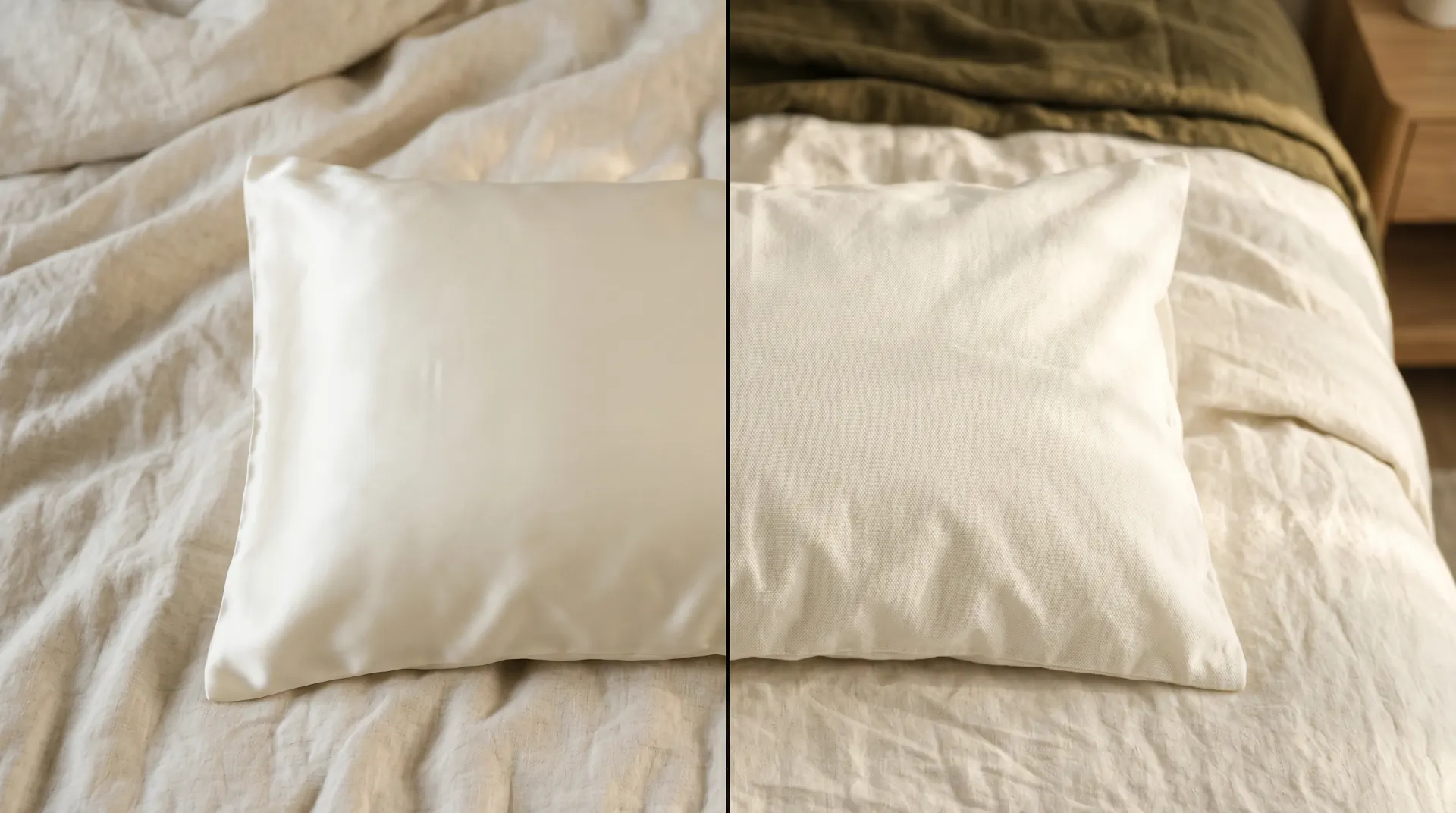
Ein Seidenkissenbezug ist glatter, kühler und feuchtigkeitsneutraler als ein Baumwollkissenbezug; Baumwolle ist günstiger, nimmt mehr Schweiss auf und übersteht intensives Waschen. Für Menschen, die auf nächtliche Reibung an Haar und Haut achten, ist Seide die bessere Wahl für den Alltag. Für Gästebetten, Kinderbetten oder alle, die einen unkomplizierten Waschalltag wollen, behält Baumwolle ihren Platz. Dieser Beitrag erläutert die Unterschiede sachlich.
Was die beiden Stoffe wirklich sind
Baumwolle ist eine Zellulosefaser. Beim Kauf zählen Stapellänge und Fadenzahl. Langstapelige Baumwolle wie Ägyptische oder Supima ergibt geschmeidigere, langlebigere Stoffe. 300–400 Fadenzahl Perkal oder Satin aus langstapeliger Faser gilt als realistische Benchmark für gute Baumwollbettwäsche. Werte über 800 sind meist Marketing.
Seide ist eine Proteinfaser – Fibroin – aus dem Kokon der Bombyx mori. Jeder Kokon liefert ein durchgehendes Filament von 800–1500 Metern. Das Mass auf Etiketten ist momme (mm): 19–22 momme ist der ideale Bereich für Kissenbezüge. Das Bewertungssystem reicht von 6A (höchste Qualität) bis 2A. Mehr in unserem Leitfaden Seiden-Momme. Die Kategorie ist unter ISO 2076:2021 reguliert. Unser Seide-vs-Satin-Leitfaden klärt die Begriffe.
Eine begutachtete Übersicht zur Biokompatibilität von Seidenfibroin findet sich in Indrakumar et al. 2024 (PMC 11177305).
Haare: Reibung ist das Argument
Der Mechanismus hinter „Seide ist besser für Haare" ist Reibung. Haarsträhnen gleiten anders über Seide als über Baumwolle. Dias 2015, Hair Cosmetics: An Overview (PMC 4387693) belegt, dass Abrieb und Reibung Haarschäden durch Proteinverlust verursachen. Die American Academy of Dermatology zählt Stoffreibung zu den vermeidbaren Schadensquellen.
Wir nennen keine genauen Prozentwerte. Die Zahlen „43 % weniger Bruch" stammen aus markeneigenen Labortests, nicht aus RCTs. Bislang misst keine peer-reviewte Studie Seiden- vs. Baumwollkissen-Haarbruch direkt im Vergleich.
Der Vorteil ist am grössten bei texturiertem Haar (3A–4C), wo Verhakungen das nächtliche Hauptproblem sind. Für glattes oder feines Haar (1A–2C) hilft Seide gegen Frizz, der Unterschied bleibt aber kleiner. Wer eine Haarschicht statt einen Kissenwechsel sucht, findet Alternativen in unserer Seidenhauben-Kollektion.
Haut: Feuchtigkeit, Talg und Reizungen
Drei relevante Unterschiede:
Feuchtigkeit. Seide absorbiert rund 11 % ihres Gewichts an Feuchtigkeit; Baumwolle nimmt mehr Wasser auf, hält es aber. An feuchten Nächten wirkt Baumwolle klamm, Seide bleibt eher trocken. Padamwar et al. 2005 (PubMed 17168872) misst die feuchtigkeitsbewahrende Wirkung von Seidenproteinen.
Talgaufnahme. Baumwolle saugt nächtlichen Talg und Produktrückstände stärker auf als Seide. Das kann ein Vorteil sein – oder ein Problem, wenn der Bezug selten gewaschen wird.
Reizung und Grenzen der Evidenz. Kleine RCTs zeigen positive Effekte von Seide bei atopischer Dermatitis (Ricci 2004 PubMed 14746626; Hung et al. 2019 PMC 7137929). Die grösste unabhängige Studie – CLOTHES Trial 2017 (PLOS Medicine, 300 Kinder) – fand keine signifikante EASI-Verbesserung. Seide ist sanfter, aber kein Medikament.
Temperatur und Atmungsaktivität
Seide ist berühmt für ihre Temperaturregulation: kühl im Sommer, warm im Winter. Baumwolle ist atmungsaktiv, kann bei höherer Wasseraufnahme aber klamm werden. Wer warm schläft, bevorzugt meist 19–22 momme Seide; wer den knackigen Griff von Perkal mag, bleibt bei Baumwolle.
Haltbarkeit, Pflege und Preis
Baumwolle ist robust. Langstapelige Baumwollkissenbezüge halten 2–5 Jahre im täglichen Gebrauch.
Seide verlangt Pflege: kaltes Wasser, pH-neutrales Waschmittel, Wäschenetz, Schonprogramm, an der Luft trocknen ohne direkte Sonne. Waschen alle 7–10 Tage. Mit dieser Pflege hält ein 19–22 momme 6A Maulbeerseiden-Bezug realistisch 5–10 Jahre. Unser Seidenpflege-Leitfaden liefert die Details.
Preisrahmen: Langstapelige Baumwolle 20–50 USD; 22-momme 6A Maulbeerseide 60–150 USD. Auf fünf Jahre gerechnet schmilzt der Kostenunterschied pro Nacht deutlich.
Ökologisch: Astariul et al. 2023 (Sustainability 15(9), 7670) misst Seide eine hohe Cradle-to-Gate-Treibhauswirkung pro kg zu. Das Argument zugunsten von Seide liegt in der Langlebigkeit – weniger Ersatzkäufe.
Entscheidungsrahmen
Baumwolle gewinnt für Gästebetten, Kinder, knappes Budget oder Hochtemperaturwäsche.
Seide gewinnt für täglich genutzte Hauptbetten, texturiertes Haar (3A–4C), reaktive Haut, warme Schlafende oder wer Kosten pro Nutzung statt Einkaufspreis priorisiert. Für reinen Haarschutz ohne Bezugwechsel siehe die Seidenhauben-Kollektion.
In vielen Haushalten findet sich beides: Baumwolle in Gästezimmern, Seide im Hauptbett.
Häufige Fragen
Seide oder Baumwolle für Haare?
Für lockiges oder krauses Haar (3A–4C) ist Seide die klarere Wahl. Für glattes Haar haben beide ihre Berechtigung; Seide hat einen leichten Vorsprung bei Frizz. Mechanismus: Dias 2015.
Hilft Seide bei Akne?
Möglicherweise marginal – nicht als Behandlung, sondern durch weniger Talg und geringere Reibung. Eine registrierte RCT (NCT06142487) läuft noch.
Wie viel teurer ist Seide wirklich?
Langstapelige Baumwolle ca. 20–50 USD; 22-momme 6A Maulbeerseide 60–150 USD. Auf fünf Jahre nähert sich der Preis pro Nutzung.
Maschinenwäsche möglich?
Ja – kaltes Wasser, Schonprogramm, Wäschenetz, pH-neutrales Mittel. Nie heisses Wasser, nie Bleichmittel, nie Trockner. Siehe Pflege-Leitfaden.
Was ist im Sommer kühler?
Seide wirkt meist kühler. Bei sehr starkem Schwitzen kann Perkal-Baumwolle die bessere Wahl sein.
Fazit
Beide Fasern haben ihren Sinn. Baumwolle ist haltbar, günstig, pflegeleicht. Seide ist glatter, thermoregulierend und sanfter zu Haar und Haut – mit höherem Einstandspreis. Der CLOTHES Trial erinnert: Seide ist sanfter, nicht magisch. Für das Bett, in dem Sie wirklich schlafen, empfehlen wir Seide. Stöbern Sie in unseren Seidenkissenbezug- und Bettwäsche-Kategorien und lesen Sie unseren Pflege-Leitfaden.
Allgemeine Textilhinweise. Komfort variiert je nach Person und Produkt; kein Stoff garantiert ein Schlaf- oder medizinisches Ergebnis.