Journal
Best Silk Bonnet for 4C, Curly & Natural Hair in 2026: Complete Guide by Hair Type
April 21, 2026
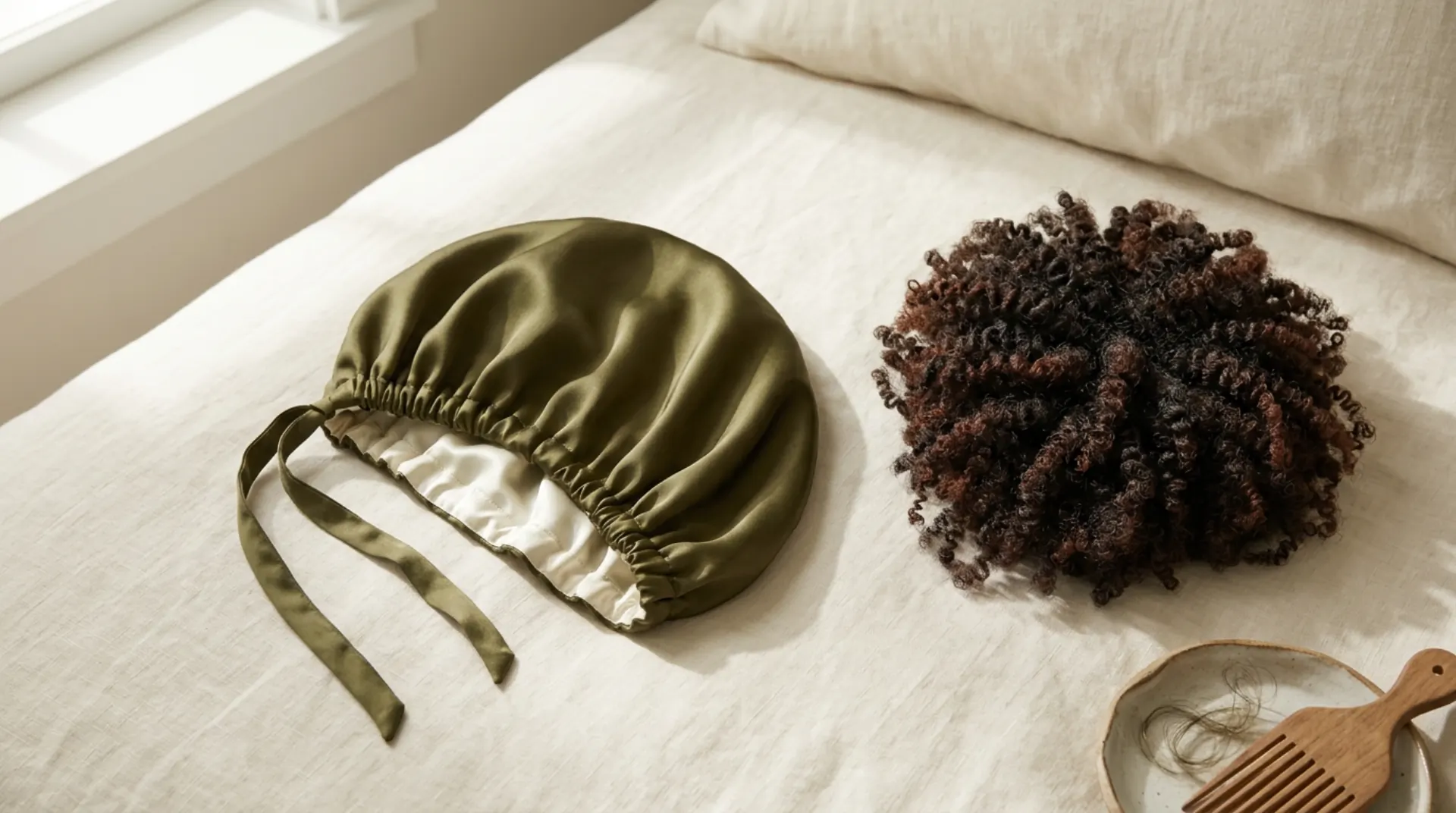
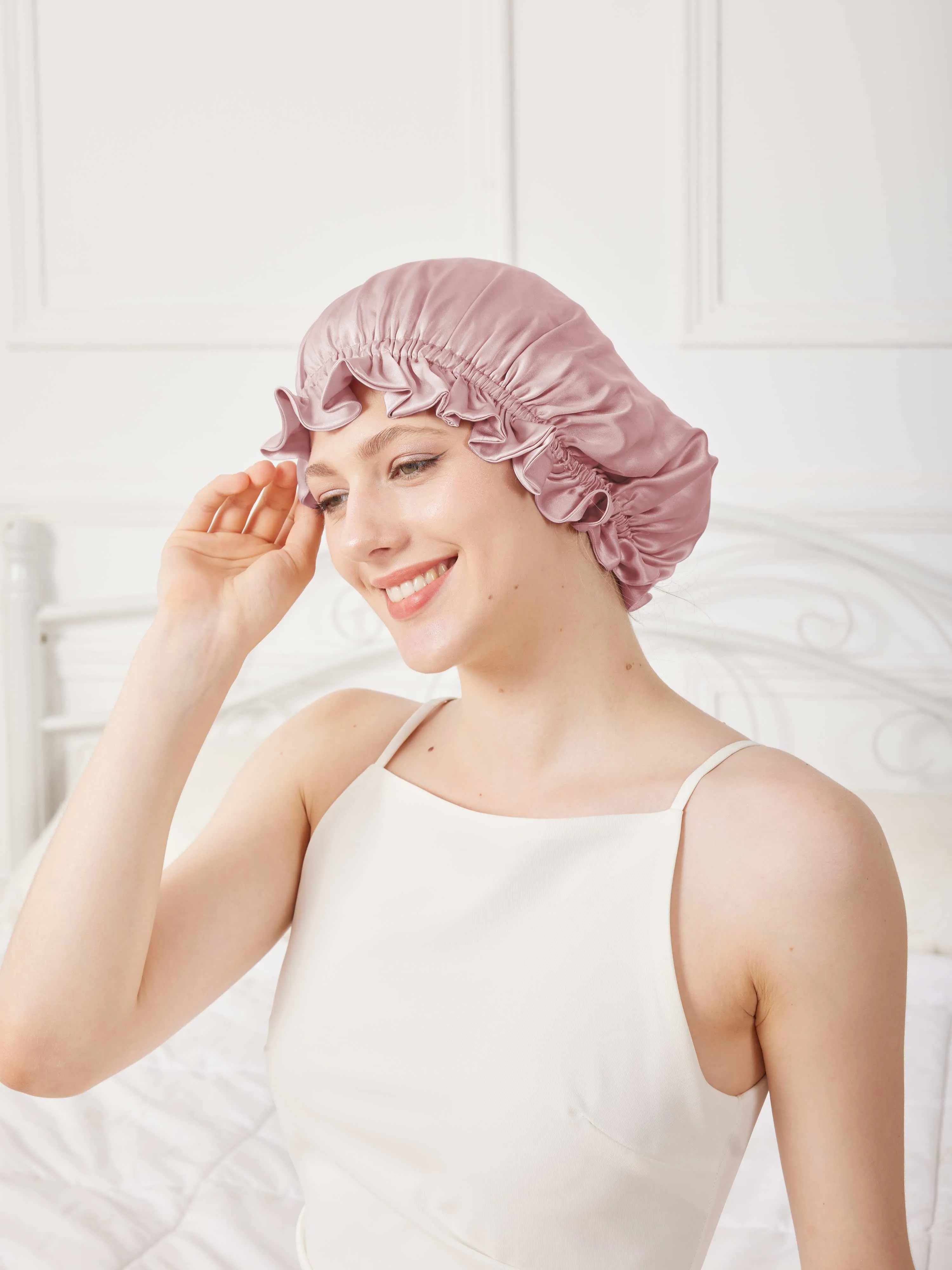
If you have ever bought a silk bonnet that slid off your coils by 3 a.m., compressed your 3C curls into a flat pineapple, or squeezed your box braids into a tight little knot at the crown — the problem is almost never the silk. The problem is that the bonnet was not designed for your hair type.
The right silk bonnet for a 4C natural is not the same bonnet that suits a 2A wavy. Coily hair needs volume, seam-free interiors, and higher momme to resist friction. Straight hair needs a snug, low-profile fit that wicks scalp oil. This guide walks through every hair type in the Andre Walker system (1A through 4C), what to look for in a silk bonnet at each texture, and which of our 22-momme mulberry silk bonnets we recommend for each.
Why Hair Type Determines the Right Bonnet
Most bonnet buying guides treat silk as a single product category. It is not. A bonnet is a protective enclosure, and the correct enclosure is dictated by the hair it protects — its diameter, its moisture needs, the volume of any protective style, and how the strands react to friction.
Research in the International Journal of Trichology documents that curly and coily textures are disproportionately vulnerable to breakage from mechanical stress, partly because the asymmetric follicle produces uneven cuticle coverage along each strand. Friction from a cotton pillowcase — or from the wrong bonnet — is not a neutral event for type-4 hair. It is cumulative damage.
That is why we segment this guide by texture. The correct bonnet for a 4C protective style with box braids is structurally different from the correct bonnet for fine 1B hair. Get the match right and overnight friction becomes a non-issue.
The Andre Walker Hair-Typing System
The Andre Walker system, developed by Oprah's longtime stylist, classifies hair into four families with three sub-categories each. It is not a clinical diagnostic tool (the American Academy of Dermatology notes that dermatologists look at follicular and scalp health rather than letter-number curl classifications), but it remains the most widely used shorthand for describing texture at the consumer level — and it maps cleanly to product selection.
| Type | Pattern | Diameter tendency | Shrinkage | Friction risk |
|---|---|---|---|---|
| 1A | Poker-straight, fine | Fine | 0% | Low, but oil-slippage high |
| 1B | Straight with slight body | Medium | 0-5% | Low |
| 1C | Straight, coarse | Coarse | 5% | Medium |
| 2A | Loose S-wave | Fine | 5-10% | Medium |
| 2B | Defined wave | Medium | 10-15% | Medium |
| 2C | Strong wave, some curl | Medium-coarse | 15-20% | High |
| 3A | Loose spiral curl (sidewalk-chalk diameter) | Medium | 20-30% | High |
| 3B | Springy curl (Sharpie diameter) | Medium | 30-40% | High |
| 3C | Tight corkscrew (pencil diameter) | Medium-coarse | 40-50% | Very high |
| 4A | S-pattern coil (crochet-needle diameter) | Coarse | 50-60% | Very high |
| 4B | Z-pattern coil, less defined | Coarse | 60-70% | Extreme |
| 4C | Tightest Z-coil, densely packed | Coarse, fragile | 70-80% | Extreme |
The three numbers that drive bonnet selection most are: shrinkage (determines how much volume you need to cover), friction risk (determines required momme weight), and diameter / fragility (determines seam placement and lining preferences).
4C Hair: The Most Demanding Bonnet Selection
We are starting at 4C because it is the hair type most under-served by the generic bonnet category. 4C coils have the tightest Z-pattern, the highest shrinkage (commonly cited at 75-80%), and strands that are simultaneously coarse and fragile — the cuticle is dense but the cortex is prone to hygral swelling and mid-shaft breakage.
What 4C Hair Does Overnight
While you sleep, 4C hair expands. A pineapple'd wash-n-go can nearly double in volume as strands relax and re-coil throughout the night. Any bonnet that constrains this expansion flattens the coil pattern and forces strands to rub against each other — the exact mechanism dermatologists describe as the root cause of mid-shaft breakage in coily textures.
Why Silk Specifically Helps 4C
Silk's low friction coefficient is well-documented in the hair-cosmetics literature (Dias 2015, PMC4387693). Brand lab tests (Mulberry Park Silks, Blissy) report friction reductions of ~30-43% vs cotton; these are directional, not peer-reviewed. This matters exponentially more as strand fragility rises. For 1A hair, the difference between cotton and silk is a matter of shine and split ends. For 4C, it is the difference between waking up with intact coils and waking up with a halo of broken strands on the pillow.
Silk also preserves moisture. 4C hair tends toward low porosity — the cuticle lies flat, which makes it hard for water to get in but also means that once moisture is inside, evaporative loss through a cotton or satin bonnet accelerates dryness by morning. Mulberry silk's smooth protein fibre helps reduce moisture loss in ways polyester satin does not replicate, independent of thread count. (Note: consumer silk textiles are degummed and retain only trace sericin — the benefit here is primarily from the fibroin fibre structure.)
What to Look For in a 4C Silk Bonnet
- Capacity over style. You need a bonnet that fits your hair at its fullest — including wash days with stretched coils, or twist-outs on day one. Measure your head circumference + 4 inches of vertical clearance at minimum.
- 22 momme or higher. Higher momme means denser weave and lower friction transfer per square inch. For the full science, see our momme weight guide. 19 momme is the absolute floor for coily hair; we build our bonnets at 22.
- Flat-seam or seamless interior. Raised interior seams are breakage hotspots when 4C coils press against them. Our bonnets use flat-lock interior seams to eliminate this.
- Adjustable tie or wide elastic band. Narrow elastic creates a tension line around the hairline — exactly where traction alopecia starts. A tie or a wide (2"+) elastic band distributes pressure.
- Double-layered construction. A silk-on-silk interior/exterior prevents any cotton or polyester lining from contacting your hair.
Our Pick for 4C Hair: The Long-Tie Silk Bonnet
For 4C coils, our Long-Tie Silk Bonnet ('BowTie') is the one we recommend. The long tie lets you cinch to exactly the right tension for your hairline (no traction alopecia risk), the interior is pure 22-momme mulberry silk on both faces, and the capacity comfortably holds a full twist-out or wash-n-go without flattening.
For extra volume or a protective style like mini twists, also consider our Long Half-Elastic Back Silk Bonnet ('ForeFree') — the extra length accommodates mid-back-length coils with zero crown compression.
Shop silk bonnets for your hair type
Every bonnet in our range is 22-momme quality-checked mulberry silk. Free shipping on orders over $80.
Type 3 Hair (3A, 3B, 3C): Curly
Type 3 sits between the low-friction demands of wavy hair and the maximum-protection needs of coily hair. The curl diameter ranges from sidewalk-chalk (3A) to pencil (3C), and the overnight challenge is preserving curl definition without crushing it into the pillow.
How 3A-3C Hair Behaves Overnight
Type 3 hair has a mid-range porosity — the cuticle lifts enough to admit and lose moisture readily. Overnight, you are fighting two things simultaneously: frizz (cuticle friction against the bonnet fabric) and curl flattening (physical compression of the spiral). The "pineapple method" — piling hair into a loose top-knot at the crown — works for type 3 specifically because it keeps the curl pattern suspended rather than smashed.
Why Silk Helps Type 3
A 2007 study in the Journal of Cosmetic Science measured wet and dry hair breakage across different fabric contact surfaces and found that smoother textile interfaces correlate with significantly fewer long-segment breaks. For 3C in particular — where each strand has the highest number of internal curl bends per inch — any reduction in surface friction translates to visibly better next-day definition.
What to Look For in a Type 3 Bonnet
- Top-volume capacity. The bonnet has to accommodate a pineapple comfortably. Look for dome-shaped designs with 4"+ of crown clearance.
- Reversible or satin-adjacent exterior. Some 3A/3B clients prefer a ruffled or shaped exterior for a more put-together look during morning routines — silk is fully compatible with decorative outer layers.
- 22 momme for 3C, 19-22 for 3A-3B. Tighter curls sit closer to the fabric more of the time; higher momme buys extra protection where you need it.
Our Pick for Type 3: The Ruffled Reversible Silk Bonnet
Our Ruffled Reversible Silk Bonnet ('SilkRuffle') is our most-recommended pick for 3A-3C. The ruffled band gives you two looks (tucked smooth or ruffled out), and the reversible construction lets you pair colorways. The dome shape gives the right crown volume for a pineapple without over-sizing.
See our sibling post on silk for curly hair for full curl-care routine context, or read the complete 2026 guide to silk for every curl type for the broader picture.
Type 2 Hair (2A, 2B, 2C): Wavy
Wavy hair gets less attention in bonnet guides because it does not look fragile. It is. Type 2 strands have the highest proportion of surface-level frizz to curl-definition ratio — meaning that the friction damage that shows up on type 4 as broken coils shows up on type 2 as chronic frizz and mid-length dullness.
What to Look For in a Type 2 Bonnet
- Lower-profile fit. Unlike type 3 and 4, wavy hair does not need crown volume. A snug, low-profile bonnet preserves wave definition.
- Back-tie adjustment. Fine wavy hair (2A) slides in elasticized bonnets. A tie keeps it in place without compressing the scalp.
- 19-22 momme. For most type 2 wearers, 19 momme is adequate; 22 if you tend to thrash in your sleep or notice frizz by morning.
Our Pick for Type 2: Back-Tie Silk Bonnet
Our Back-Tie Silk Bonnet ('SilkTie') is the low-profile, tie-adjustable pick for waves. Because the tie sits at the nape (not at the front hairline), there is zero visible pressure line in the morning — an issue we hear about regularly from 2A wearers with fine hair.
Type 1 Hair (1A, 1B, 1C): Straight
Type 1 wearers are often skeptical about needing a bonnet at all. The data does not support the skepticism. Straight hair has the highest reflective shine — meaning any cuticle disruption from friction shows up immediately as dullness. It also accumulates scalp oil fastest, and cotton pillowcases absorb that oil and redistribute it back onto the hair over subsequent nights.
What to Look For in a Type 1 Bonnet
- Smooth interior, minimal seams. Fine strands catch easily.
- 19 momme is enough. For straight hair, friction risk is the lowest of any type; 19 momme protects adequately.
- Breathability. Straight-haired wearers tend to run warmer at the scalp — a breathable silk weave outperforms synthetic satin dramatically.
Our Pick for Type 1: Reversible Floral Print Silk Sleep Cap
The Reversible Floral-Print Silk Sleep Cap ('KidDuo') is our type 1 pick — low-profile, snug, and breathable. The reversible floral print gives you two looks in one cap.
Why Mulberry Silk Beats Satin (Regardless of Hair Type)
This is the single most important section for every hair type 1A through 4C: satin is not silk. Satin is a weave pattern (the characteristic smooth-face, dull-back construction), and satin can be woven from polyester, rayon, or silk. "Satin bonnets" sold cheaply online are almost always polyester satin — a plastic fiber that generates static, cannot breathe, and often fails basic fabric and finish checks.
Mulberry silk is a protein fiber, chemically closer to your own hair than to any synthetic. It wicks moisture, regulates scalp temperature, is naturally breathable (silk's sericin protein has been studied for potential antimicrobial activity, though consumer silk textiles are largely degummed and contain minimal residual sericin), and does not generate static regardless of humidity.
For the full comparison including care and durability, read our silk vs. satin guide.
Momme Weight Matters More for Coarse Hair
Momme is the weight of silk measured in pounds per 45"×100-yard bolt. A 22-momme silk has noticeably more fabric density than 19-momme. For fine hair, this difference is marginal. For 4C, 3C, or protective-style wearers, 22-momme is functionally different: it drapes more, slides less, and produces fewer micro-abrasions across the night.
We build every bonnet in our range at 22 momme minimum. For the full technical explanation, see our momme weight guide.
How to Put On and Care For Your Bonnet
For wash-n-go wearers and protective-style wearers, putting on a silk bonnet is not intuitive — there are methods that preserve your style and methods that destroy it in 30 seconds. Our full silk care guide walks through the gentle-wash routine, but the overnight basics:
- Hair should be damp, not wet. Wet hair plus any bonnet = risk of hygral fatigue; see our wet-hair bonnet guide.
- For type 3 and 4, pineapple or loosely gather hair at the crown before putting on the bonnet.
- Pull the bonnet over from front to back, not back to front — this preserves edge laid-ness.
- Adjust any tie so it is snug at the nape but not tight. You should be able to slip one finger under it comfortably.
- Hand-wash weekly with pH-neutral silk detergent in cool water; air-dry flat.
Size and Fit Guide
Bonnet sizing across the industry is inconsistent. Use this table as a starting reference, then consult the specific product page for exact measurements.
| Hair length | Head circumference | Recommended style | Fit note |
|---|---|---|---|
| Pixie to chin-length | 21"-22" | Back-tie or sleep cap | Any bonnet style fits; comfort is primary. |
| Shoulder-length | 22"-23" | Ruffled reversible or back-tie | Standard adult sizing. |
| Bra-strap length | 22"-23" | Long-tie or long half-elastic | Needs crown capacity; avoid snug sleep caps. |
| Mid-back or longer | 23"+ | Long half-elastic back | Explicitly long-silhouette bonnet required. |
| 4C natural with twist-out | 22"-24" | Long-tie, adjustable | Tie lets you cinch or loosen night-to-night. |
| Box braids or locs | Measure braids, add 4" | Long half-elastic, XL | Bonnet must contain full braid volume. |
Not sure which bonnet fits your hair type?
Our team can recommend a match based on your texture and routine.
Frequently Asked Questions
What size silk bonnet do I need for 4C hair with box braids?
For shoulder-length or longer box braids, measure the bundled braids at their widest point, add 4 inches of clearance for comfort, and pick a long-silhouette bonnet (our Long Half-Elastic Back is designed for this). Standard-size bonnets will compress braids at the crown, creating friction points that fray the braid over weeks.
Can I wear a silk bonnet with a wash-n-go on 4C hair?
Yes — this is one of the primary use cases for a high-capacity silk bonnet. Let the wash-n-go air-dry to at least 80% before bonneting to avoid hygral fatigue. Our Long-Tie Bonnet accommodates a pineapple'd wash-n-go without compressing the coils.
Do silk bonnets flatten curls overnight?
Only if the bonnet is undersized for your hair. A properly-sized silk bonnet (with 4"+ of crown clearance for type 3 and 4" for type 4) preserves curl pattern. A too-tight bonnet on any hair type will flatten — this is a fit problem, not a silk problem.
How often should I replace my silk bonnet?
With proper care (weekly cool hand-wash, air-dry, no bleach), a 22-momme mulberry silk bonnet lasts 2-3 years of nightly use. Replace when you see visible pulls, pilling, or elastic slack. For frequent wash-n-go wearers, 18 months is more realistic.
Is a satin-lined silk bonnet better for 4C hair than pure silk?
No. A "satin-lined" bonnet means the interior is polyester satin — which defeats the purpose. Pure mulberry silk on both interior and exterior is the correct construction for 4C hair. Every Muriersilk bonnet is 22-momme mulberry silk on both faces.
Ready to Find Your Bonnet?
Every silk bonnet in our range is 22-momme mulberry silk with fabric and finish checks, hand-finished in small batches. Free US shipping on orders over $80, and a 30-day comfort guarantee if the size is wrong.
Further reading:
- Can you put a silk bonnet on wet hair?
- Silk for curly hair: the complete curl-care guide
- Best silk bonnets of 2026
- Silk vs. satin: what you are actually buying
- Momme weight explained
- How to wash and care for silk
- How to prevent silk shrinking and deformation
Last updated April 21, 2026. This article references peer-reviewed research in dermatology and trichology, including the International Journal of Trichology and the Journal of Cosmetic Science. Bonnet recommendations reflect the current Muriersilk product range and are updated as new SKUs launch.
General textile guidance only. Comfort varies by person and product; no fabric guarantees a sleep or medical outcome.