Silk for Curly Hair: A Complete 2026 Guide for All Curl Types

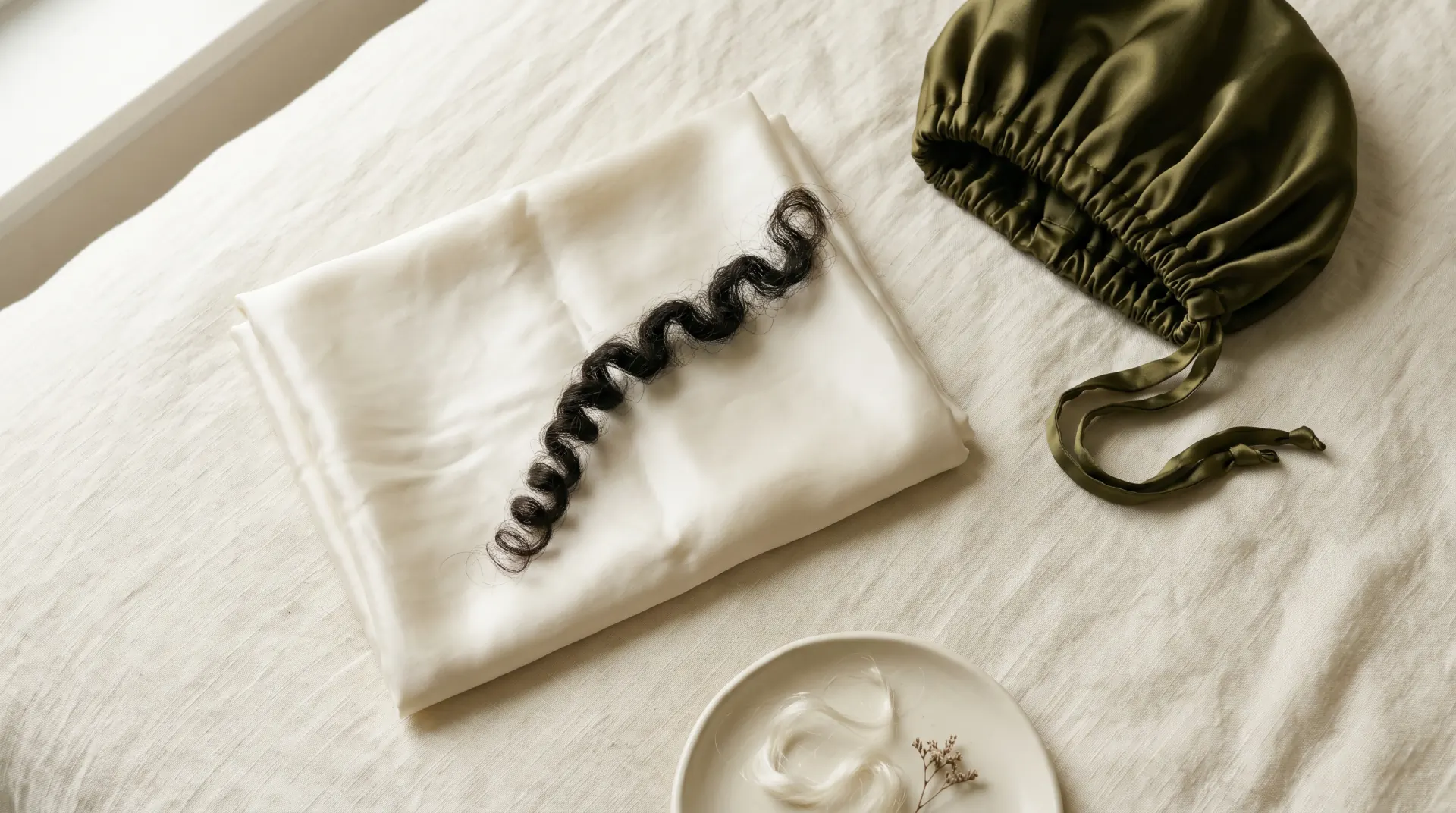
Mulberry silk pillowcase, silk bonnet, and a coily curly hair tendril on cream linen — silk for curly hair routine flat lay

Silk supports curly hair through low surface friction and moisture preservation — both of which protect the cuticle layer that defines a curl. The same fibre behaves slightly differently across curl families, so the right format (pillowcase, bonnet, scrunchie, turban) depends on whether you have 2A waves, 3B ringlets, or 4C coils. Here is what works for each curl type, what the science actually says, and what silk cannot do.

What silk actually does for curly hair

A curl is not a uniform spring. Each bend in the strand is a point where the cuticle layer — the overlapping plate-like outer surface of the hair shaft — is more lifted and more exposed than on the straight section. That makes curls vulnerable to two specific forms of damage: mechanical friction and moisture loss.

Friction. Dias 2015 (International Journal of Trichology) writes that "abrasion and friction are important factors that cause hair damage by protein loss." Charmeuse silk has one of the lowest skin- and hair-contact frictions of any commercial natural textile. That matters more for curly than straight hair because every curl bend offers more cuticle edge for a rough surface to catch on.

Moisture and the cuticle. Padamwar 2005 (Journal of Cosmetic Dermatology) reported a human in-vivo trial showing that silk sericin restored amino acids on the skin surface and produced an occlusive effect that reduced trans-epidermal water loss. That study tested topical sericin, not pillowcase fabric — but it establishes that silk proteins have measurable moisturising properties, which is the mechanistic basis for sleeping curly hair on silk after applying a leave-in or curl cream. The cream stays on the strand instead of soaking into the pillow. A 2024 review of silk fibroin by Indrakumar et al. (ACS Polymers Au) further documents the protein fibre's biocompatibility and skin-friendly amino-acid profile.

Cuticle integrity. The American Academy of Dermatology's habits-that-damage-hair guidance highlights that rough sleeping surfaces, tight elastics, and aggressive brushing all wear down the cuticle on textured hair. Silk addresses the sleeping surface by replacing cotton's grippy weave with a smooth charmeuse face.

A note on numbers online. Many silk brand pages cite "43% less friction" or "40% fewer split ends." These come from in-house brand lab tests, not peer-reviewed RCTs. As of 2026 there is no published RCT directly measuring silk-pillowcase versus cotton-pillowcase outcomes for curly hair. The mechanism is well established; the exact percentages are not.

2A, 2B, 2C wavy hair: the lightest curl

Type 2 hair has a soft S-pattern that hangs more than it springs. Type 2A is loose body waves; 2C is more defined and prone to frizz at the canopy.

Primary risk: wave compression and frizz. Type 2 hair loses definition overnight when waves are squashed against a pillow, and canopy strands frizz when they catch on cotton.

Best silk format: a silk pillowcase is usually enough. Type 2 strands are not tightly bound, so a bonnet often flattens the waves. A 22-momme mulberry silk pillowcase preserves the wave pattern without crushing it. For depth on momme weight see our Silk Momme Weight Guide.

Sleep technique: if your waves elongate during the day, sleep with hair gathered loosely on top of your head and held with a silk scrunchie (the "pineapple" method). For 2C hair on a heavy-product wash day, a roomy silk bonnet is sometimes worth the trade-off — wash-day curls are denser than sleep-day waves and benefit from full enclosure.

3A, 3B, 3C curly hair: the springy middle

Type 3 hair is the classic "ringlet" range. 3A is loose corkscrews, 3B is springy bouncy curls, 3C runs into tight corkscrews at the dense end.

Primary risk: definition loss and frizz at the curl perimeter. Type 3 curls hold their shape when undisturbed and unravel when rubbed against a rough surface. The looser the curl, the easier it is to lose definition; the tighter the curl, the more cuticle edge catches on cotton.

Best silk format — depends on density and length:

  • 3A short to medium: silk pillowcase is usually sufficient with the pineapple on top.
  • 3B medium to long: silk pillowcase plus a silk scrunchie pineapple, or a roomy silk bonnet (not a tight elastic cap). Tight bonnets crush the springy pattern.
  • 3C dense or long: silk bonnet with a wide soft band, or a silk turban that contains volume without compressing it. Avoid narrow elastic — it leaves a dent in the canopy that takes 2-3 days to recover.

Wash-day extension. If your wash routine takes 30+ minutes (curl cream, gel cast, scrunch, dry), silk overnight protection often extends a wash from 2-3 days to 4-5 days. The bonnet preserves cast integrity better than the pillowcase because no surface contact disturbs the pattern.

4A, 4B, 4C coily and natural hair: the most fragile

Type 4 is the densest, most fragile, and most cuticle-exposed of the curl families. 4A coils are visible spirals; 4B is a sharp Z-pattern with less defined coils; 4C is the densest, with shrinkage that can hide 75-80% of strand length.

For 4A through 4C, silk is no longer optional — friction protection becomes the central mechanism for length retention. A dedicated guide on this curl family lives at our Silk Bonnet for 4C, Curly & Natural Hair Complete Guide 2026, which covers fit, momme weight, the Andre Walker typing system, and product picks by sub-type. Three principles for all type-4 hair:

Bonnet over pillowcase. Type 4 hair sheds and tangles on cotton overnight in ways type 2 and 3 do not. Full enclosure in silk is the difference between a wash-and-go that lasts three days and one that lasts a week.

Width and depth matter. A silk bonnet for 4C must accommodate volume without compressing the crown. Wide soft bands, oversized back panels, and turban styles outperform narrow elastic caps. The 4C guide maps specific products to sub-types.

Silk supports, does not replace. Type 4 hair is more vulnerable to over-washing and over-manipulation than other curl types. Silk supports your routine; it does not replace co-washing, leave-in, or curly-hair products you have already validated for your texture.

Silk pillowcase versus silk bonnet for curly hair: a decision framework

Both work. The right choice depends on curl tightness, hair length, and how much you move at night.

Pillowcase. Protects whatever is touching the pillow. Good for type 2 hair, short type 3 hair, and as a baseline for everyone (silk pillowcases also benefit skin). Downside: as you turn during sleep, hair leaves the pillow and contacts whatever sheet is under it. Protection is partial.

Bonnet. Encloses the whole head. Best for type 3C, all of type 4, hair past shoulder length, side-sleepers, and active sleepers. Downside: a bonnet that fits poorly slides off by 3 a.m. or compresses the crown. Look for a wide soft band, fully lined construction, and 22-momme charmeuse silk.

Both. The strongest setup. The bonnet protects every strand regardless of position; the pillowcase protects the face. People who care about both curl integrity and skin run both.

For sleep with damp hair specifically, see Can You Put a Silk Bonnet on Wet Hair? — short answer: lightly damp is fine, soaking wet is not.

Care: how curly-hair people should wash silk

Silk for curly hair gets dirtier than silk for straight hair, because curl creams, leave-ins, and oils all migrate from hair to fabric overnight. That is normal — it is the cream staying on your hair instead of being absorbed by cotton. But it means silk needs more frequent washing in a curly-hair routine.

Frequency. Pillowcase: every 7-10 days, or weekly with heavy curl cream. Bonnet: every 5-7 days. Invisible product residue lives in the silk, and washing prevents it from interfering with surface smoothness.

How to wash. Hand-wash in cool water with a pH-neutral silk wash. Do not use regular detergent — it is too alkaline and breaks down silk's protein structure over months. Submerge, agitate, rinse. Press water out between two clean towels (do not wring). Lay flat in shade. For the full reference, see our Silk Care Guide.

Replacement. A 22-momme silk bonnet or pillowcase, washed correctly, lasts 18-30 months under nightly use. Replace when seams thin, colour fades unevenly, or the surface no longer glides — a tired silk bonnet feels papery instead of slippery.

Common mistakes curly hair people make with silk

Five errors come up repeatedly in customer questions and review threads.

Buying "silk satin" instead of silk. Polyester satin and 100% mulberry silk are not the same fibre. ISO 2076:2021 reserves the generic name "silk" for protein silk fibre. A $9 "silk satin" pillowcase is almost always polyester — smooth, but with very different moisture and thermal properties. Polyester satin holds heat against the scalp and lacks silk's sericin amino-acid coating. Look for "100% mulberry silk" plus a momme number on the product page.

Using cotton anywhere in the sleep loop. Silk pillowcase plus cotton bonnet — or vice versa — defeats the point. Cotton at any contact point still creates friction. Match silk to silk. Likewise, replace cotton hair ties with silk scrunchies for the pineapple method; cotton elastics dent curls precisely where they grip.

Sleeping with soaking-wet hair. Damp is fine; freshly-showered dripping is not. High water content plus the closed bonnet environment over many nights can encourage scalp issues. Towel out the excess, then put hair up before the bonnet goes on.

Buying too tight a bonnet. A bonnet that leaves a band mark or compresses the crown is the wrong fit. The whole point of silk overnight is to remove pressure from the curl pattern; tight elastic adds back the compression you are trying to avoid. Wide soft bands or turban closures preserve volume.

Treating silk as a styling product. Silk does not define curls, reverse heat damage, or fix a routine that does not work. It supports the routine you have already built — low-poo or co-wash, leave-in, curl cream, gel, scrunch — by reducing overnight degradation. If wash-day curls do not last longer with silk, the issue is in the daytime routine, not the bonnet.

Where to start

Silk for curly hair is a supportive intervention — small, consistent, compounding. It will not fix heat- or chemical-damaged hair, replace your leave-in, or grow hair you do not have. What it will do, every night for 18-30 months, is reduce the mechanical and moisture stress that erodes definition and length between wash days.

For type 2, start with a 22-momme silk pillowcase. For type 3, add a roomy silk bonnet or turban. For type 4, the bonnet is the centrepiece — our Silk Bonnet for 4C, Curly & Natural Hair Complete Guide 2026 maps fit and product picks by sub-type.

Browse the Muriersilk silk bonnet collection for 22-momme mulberry silk options across wide-band, oversized, turban, and adjustable closures — designed for every curl type from 2A to 4C.

Frequently Asked Questions

The mechanism is real and peer-reviewed: lower surface friction protects the cuticle, and silk's sericin protein has measurable moisture-related effects. The exact percentages quoted online ("43% less friction," "40% fewer split ends") come from brand in-house lab tests, not RCTs — there are no published silk-pillowcase versus cotton-pillowcase RCTs for curly hair as of 2026. Treat silk as a supportive textile for curl integrity, not a curl-defining or growth product. **Is a silk pillowcase enough, or do I need a bonnet?** For loose waves (type 2) and short type 3 curls, a silk pillowcase alone usually works. For type 3C, all of type 4, and any hair past shoulder length on an active sleeper, a silk bonnet adds meaningful coverage that the pillowcase cannot match because hair leaves the pillow as you turn. Many people run both for full coverage. **What momme weight is best for curly hair silk?** 22 momme is the safest premium choice for both pillowcases and bonnets. It is heavy enough to last 18-30 months of nightly use, smooth enough to glide over curls, and dense enough to hold cream against the strand. 19 momme is acceptable for lighter wear or warmer climates. Skip anything below 16 momme for nightly use — it pills and fingertip-thins within months. See our [Silk Momme Weight Guide](/guides/momme-weight) for the full breakdown. **Can silk help with hair growth?** Silk does not stimulate growth, and any product or fabric promising to do so is overclaiming. What silk does, by reducing mechanical breakage at the cuticle, is help you retain length you have already grown. If your hair breaks at the same rate it grows, growth seems invisible. Silk addresses the breakage side of the equation, not the growth side. A clinician should manage any genuine hair-loss concern. **Should I replace cotton hair ties with silk scrunchies?** If you wear hair tied up overnight or for the pineapple, yes. Cotton or rubber elastics dent and break curls at the gripped point. Silk scrunchies hold hair without the friction and pair with a bonnet to remove cotton from every part of the sleep loop.

Shop the Collection

Explore Our Silk Collection

Premium mulberry silk accessories crafted for comfort and luxury. Free shipping over $150.

Sign up for exclusive offers

Stay informed about new products, silk care tips, and special promotions.