
Journal
Ultimate Silk Buyer's Guide 2026
May 6, 2026
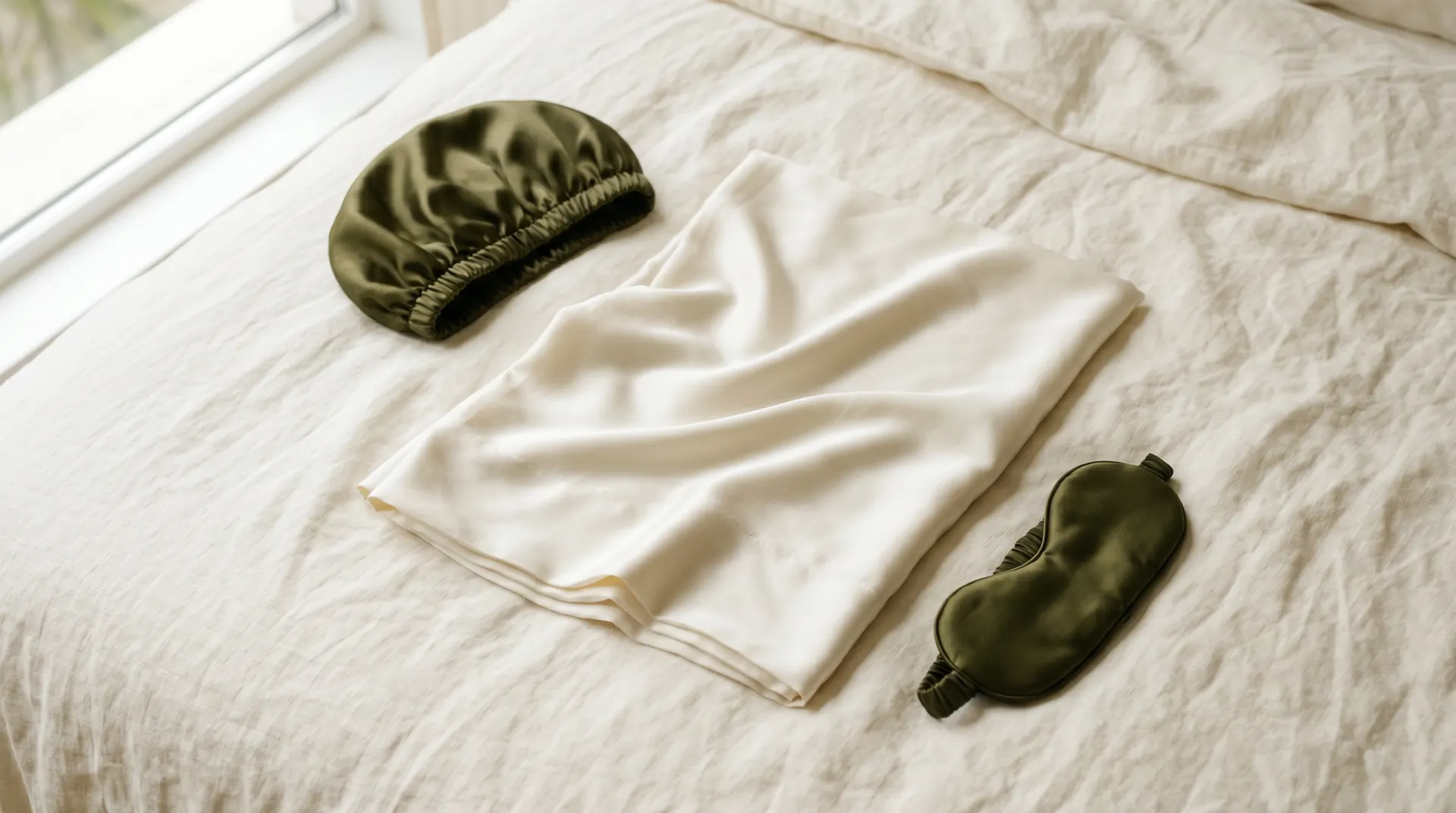
Updated April 22, 2026 · 28-minute read · Covers mulberry vs tussah, 6A grade, 19-25 momme, silk-vs-satin, hair and skin effects, category-by-category fit, real-vs-fake tests, and washing.
Silk is one of the oldest textiles humans make, and one of the most misunderstood in 2026. The word "silk" on a label can mean a 6A long-fibre mulberry weave that will outlast three cotton pillowcases, or it can mean a polyester satin that will shed its sheen after twenty washes. The difference is not aesthetic. It is structural, and it shows up in how the fabric sits against your hair overnight, how your skin feels in the morning, and how the pillowcase looks after a year on your bed.
This guide exists because most of what gets written about silk online is either a product listing or a paid review. We wanted a single reference you can send to a friend — one page that answers the questions a careful buyer actually asks before spending money on a silk pillowcase, bonnet, eye mask, scarf, or pair of gloves.
We will stay away from medical language. Silk is a fabric, not a medication. Where research exists — and in a few areas, good research does exist — we will cite it. Where the evidence is weaker, we will say so. The goal is a guide you can trust to tell you when silk is worth the premium and when a cheaper, well-chosen alternative will serve you just as well.
A quick navigation note: if you already know what momme is and just want the comparison table, jump to Section 2. If you are trying to decide between silk and satin, Section 3 is for you. Readers shopping for a specific product should skip to Section 6.
Section 1 — What Is Silk, Really? {#section-1-what-is-silk}
Silk is a protein fibre. Specifically, it is fibroin, a long-chain protein extruded by the silkworm as it spins a cocoon. Each cocoon yields one continuous filament that can run roughly 800 to 1,500 metres before it breaks. That continuous filament is the reason a well-made silk fabric has a distinctive drape: there are very few fibre ends per square inch, which is part of why the surface feels smooth against skin and hair.
Not all silk is the same. The three main categories you will meet on a label:
Mulberry silk. Spun by the domesticated Bombyx mori silkworm, which is raised on a strict diet of mulberry leaves. Because the worm is farmed under controlled conditions, the filament is unusually uniform. Mulberry silk produces the whitest, finest, and most consistent fibre — it is the standard for luxury silk bedding, sleepwear, scarves, and hair accessories.
Tussah silk (also called wild silk). Spun by wild silkworms that eat oak and other forest leaves. Tussah fibre is coarser, naturally beige-to-tan, and has a slightly nubby texture. It is beautiful in rustic scarves and throws, but it is not what you want in a pillowcase. Weave and hand feel both differ.
"Silk" that is not silk. Satin is a weave, not a fibre. Polyester satin, nylon satin, and acetate can all be sold under names that read like silk at a glance. The care label is the only reliable tell. If the label says "100% polyester" or "100% nylon", it is a synthetic satin, and the comparison in Section 3 is the one you want.
What does "6A grade" actually mean?
You will see the phrase 6A grade mulberry silk on better silk bedding and accessories. This is an industry grading system, not a legal standard — but it is widely used by Chinese and Indian silk mills and is referenced in trade publications like the China National Silk Museum and the International Silk Association. The scale runs from 6A (highest) down to 2A, with grade A used for lower-tier silk.
What a 6A label is supposed to mean, in practical terms:
- Long filament length. Fewer breaks per cocoon, which produces a smoother fabric face.
- Pure white colour. No yellowing or greying from inconsistent feeding or humidity.
- Uniform filament thickness. This affects how evenly the yarn takes dye.
- Minimal breakage during reeling. Fewer splices, fewer weak spots.
Because the grading is voluntary, a 6A label is a signal — not a guarantee. Pair it with the other signals in Section 7 (price, weave, burn test) before you trust it. Every silk product in our catalog is milled to 6A specification, but we would rather you verify than take our word for it.
Why this matters when you buy
Three-quarters of buyer confusion comes from mixing these categories. A 19-momme mulberry 6A pillowcase and a 19-momme tussah pillowcase will feel different, look different, and wear differently. A "22-momme satin pillowcase" that does not name a fibre is almost always polyester. Before you compare prices, make sure you are comparing the same thing.
Further reading on silk fibre structure: the Textile Institute's glossary.
Section 2 — Momme Weight Explained {#section-2-momme-weight-explained}
Momme (mm) is the unit silk is measured in. One momme equals the weight in pounds of a piece of silk 45 inches wide and 100 yards long. For our purposes, momme is density: higher momme means more silk fibre packed into the same area, which generally means a heavier drape, a more opaque fabric, and a more durable weave.
Momme is not quality. A 25-momme pillowcase is not automatically better than a 19-momme scarf. Each silk product has a momme range that fits its purpose.
The momme table
| Momme | Typical use | What it feels like | Our pick for this weight |
|---|---|---|---|
| 12–15 mm | Lightweight scarves, linings, lingerie | Sheer, airy, almost weightless | M-Series silk twill scarves |
| 16–19 mm | Everyday pillowcases, standard scarves, sleep bonnets | Smooth, medium drape, slight translucency in light | Entry-tier silk pillowcase |
| 19–22 mm | Premium pillowcases, hair bonnets, eye masks | Opaque, substantial, classic silk hand | Long-Tie Silk Bonnet, Silk Sleep Mask |
| 22–25 mm | Luxury pillowcases, sleep bonnets for 4C hair, sleep sets | Dense, heavy drape, excellent durability | Long Half-Elastic Back Silk Bonnet |
| 25–30 mm | Heavy-duty silk, bedding, very thick scarves, high-traffic items | Substantial, suit-lining weight | Not every product needs this weight |
| 30+ mm | Specialty / industrial silk | Rare in consumer goods | Specialty weaves only |
| 33 mm | Silk gloves (ours) | Dense enough to hold moisturizer against skin without bleeding through | Silk Gloves for Sleeping |
Which momme is right for you?
- Pillowcases: 19-22 mm is the sweet spot. Below 19 mm the fabric is thin and tears at seam stress points. Above 25 mm the price premium is hard to justify for most sleepers.
- Sleep bonnets: 19-22 mm for fine or low-density hair (types 1A-2C). 22-25 mm for dense, coarse, or high-shrinkage hair (3A-4C). Heavier fabric drapes without riding up.
- Eye masks: 19-22 mm. The mask only needs to block light and sit softly; heavier silk adds weight without benefit.
- Silk scarves for the head or hair: 16-19 mm if you want a scarf that knots cleanly; 19-22 mm if you want it to stay in place overnight.
- Silk scrunchies: 19-22 mm gives structure without leaving a crease.
- Gloves and socks: 22-33 mm. Heavier silk holds moisturizer against the skin, which is the entire point of overnight wear.
For a deeper explanation of momme, see our silk momme weight guide.
A note on "22 momme silk" versus "6A grade"
These are two different attributes, not a ladder. Momme tells you how heavy the fabric is. Grade tells you how uniform the filament is. You can have a 25-momme grade-A silk (heavy but irregular) and a 19-momme 6A silk (lighter but smoother). A good luxury pillowcase will advertise both. If only one is listed, ask.
Section 3 — Silk vs Satin (The Definitive Comparison) {#section-3-silk-vs-satin}
This is the single most common buyer confusion. Satin is a weave structure, not a fibre. You can have a silk satin (luxury), a polyester satin (synthetic), or a cotton sateen (cheap, common in sheets). When a product says "satin pillowcase" without naming a fibre, it is almost always polyester.
Side-by-side
| Attribute | Mulberry silk (6A, 19-22 mm) | Polyester satin |
|---|---|---|
| Fibre | Natural protein (fibroin) | Synthetic polymer (PET) |
| Smoothness | High, and consistent over time | High when new, degrades after ~20 washes |
| Breathability | Moderate-to-high — silk wicks and releases moisture | Low — synthetic fibres trap heat |
| Temperature regulation | Adapts to body warmth; feels cool in summer, warm in winter | Retains heat; can feel hot and clammy |
| Moisture behaviour | Absorbs ~11% of its weight in moisture before feeling damp | Hydrophobic; moisture sits on the surface |
| Durability (with care) | 5-10 years for a quality pillowcase | 1-3 years before the sheen dulls |
| Static | Very low | High, especially in dry air |
| Hair friction | Low — smooth filament face | Low when new, but coarsens as fibres break down |
| Skin feel | Soft, slightly cool, no pilling | Slick, warmer, prone to fibre release |
| Price (queen pillowcase) | $60–$150 | $10–$30 |
| Hypoallergenic claims | Naturally resistant to dust mites and mildew | Depends on finish chemistry |
When is satin a reasonable choice?
Satin is reasonable when you are buying for a child who will grow out of the item, for a travel backup, or for a single-season piece. It is not a good choice for daily-use bedding or for the pillowcase you sleep on five nights a week. The cost-per-use math almost always favours silk after the first year.
For a head-to-head on bonnets specifically, see our silk vs satin bonnet comparison. A silk-vs-cotton pillowcase comparison is forthcoming in our pillowcase content series.
A note on "silk pillowcase benefits" marketing
You will find pages on the open web that claim silk pillowcases prevent wrinkles, cure acne, or reverse hair loss. These claims go beyond what the fabric does. Silk reduces friction and manages moisture — both of which may contribute to less overnight mechanical stress on skin and hair. That is not the same as a medical benefit, and we do not make those claims on our product pages. Before you take any silk-cures-X article at face value, check the citation chain: most marketing claims trace back to brand-funded in-house lab tests, not peer-reviewed research.
Section 4 — How Silk Affects Hair {#section-4-silk-and-hair}
Silk's effect on hair comes down to one word: friction. Hair strands slide against cotton fibres differently than they slide against silk fibres, and the cumulative micro-abrasion over eight hours of sleep is the mechanism dermatology reviews point to when explaining cuticle damage from fabric contact. The peer-reviewed grounding here is Dias 2015's Hair Cosmetics: An Overview, which establishes that abrasion and friction drive hair damage via cuticle protein loss (PMC 4387693). On specific percentages: in-house lab tests by silk-pillowcase brands report friction reductions in the 30-43% range, but no peer-reviewed RCT has measured silk-cotton hair friction directly. We cite the mechanism, not the unverified numbers.
The damp vs soaking nuance
A common question: can you wear a silk bonnet on wet hair? The honest answer is that it depends on how wet.
- Damp hair — towel-dried, no dripping, about 20-30% moisture remaining — is fine in a 22-momme silk bonnet. The silk absorbs a modest amount of water without saturating, and the slow drying reduces the number of friction events overnight.
- Soaking wet hair — straight from the shower, dripping — is not fine. The fabric becomes saturated, sits heavy against the scalp, and the longer drying time creates a humid micro-environment. Our full analysis lives at Can You Sleep in a Silk Bonnet With Wet Hair?.
If you must go to bed with very wet hair, pat with a microfibre towel first, then a silk bonnet. Never go to bed in a tight cap over dripping hair.
By hair type
Silk interacts differently with each of the Andre Walker hair types (1A-4C). A compressed summary:
- Type 1 (straight): Reduces overnight frizz; minimal curl preservation issue. A 19-22 mm standard bonnet or silk pillowcase works.
- Type 2 (wavy): Helps preserve wave definition; silk pillowcase plus a loose silk scarf works for most.
- Type 3 (curly, 3A-3C): Significant benefit to curl preservation overnight. A structured silk bonnet with a gathered or ruffled crown — see the Ruffled Reversible Silk Bonnet — gives room for the curl.
- Type 4 (coily, 4A-4C): Highest benefit. 22-25 momme silk is worth it. Deep-crown designs like the Long Half-Elastic Back Silk Bonnet keep the coils off the friction zone.
Our full hair-type walk-through: Best Silk Bonnet for 4C, Curly & Natural Hair.
What silk does not do
Silk does not regrow hair. It does not cure a dry scalp. It does not replace a conditioner. What it may do — and the research is suggestive rather than definitive — is reduce the number of mechanical breakage events per night, especially on textured hair. That reduction can accumulate into visibly less breakage over months. It is not a medical intervention.
For the underlying research, Dias 2015's Hair Cosmetics: An Overview (PMC 4387693) is the peer-reviewed mechanism anchor — it establishes that abrasion and friction cause hair damage by protein loss at the cuticle. The American Academy of Dermatology's hair and scalp care page is the gentle-handling primer we recommend alongside any silk purchase.
Section 5 — How Silk Affects Skin {#section-5-silk-and-skin}
Silk's effect on skin has three mechanisms: mechanical (friction), thermal (temperature regulation), and hygroscopic (moisture). We will take them in order, and we will stay within what the evidence supports.
Sleep lines and mechanical creasing
If you sleep on your side, your pillowcase compresses one side of your face for hours each night. The cumulative creasing is visible in the morning and, over years, may contribute to more durable lines in the skin. A silk pillowcase reduces the tension on the skin because the fabric slides with the face rather than pulling against it. This is a mechanical effect, not a medical one. Mainstream dermatology coverage treats it as a comfort and friction argument, not an anti-ageing one — and we do the same.
Temperature regulation
Silk is a natural protein fibre with a fine, hollow structure that allows moisture vapour to move through the fabric more readily than through synthetic satin. In practical terms, this means a silk pillowcase or eye mask tends to feel cooler in summer and warmer in winter than a polyester equivalent. The effect is modest and depends on room temperature and body weight, but it is real.
Moisture behaviour
Silk can absorb roughly 11% of its own weight in moisture before it feels damp to the touch. Cotton absorbs more, which is why a cotton pillowcase can feel clammy on a humid night, while a silk one stays closer to dry. This may be part of why sleepers with sensitive or reactive skin report a gentler morning experience on silk, though individual results vary and we would not call this a treatment. See our Do Silk Sheets Make You Sweat? post for the nuanced version.
Acne and sensitive skin
Is silk good for acne? The honest answer is: it may help marginally, not by treating acne, but by reducing two of the environmental factors that can irritate already-reactive skin. Silk absorbs less sebum than cotton, which means the pillowcase surface stays cleaner between washes. It also reduces friction against the jawline, cheeks, and hairline — the zones most prone to mechanical acne. It is not a substitute for a dermatologist-recommended routine. The American Academy of Dermatology has published general guidance on sensitive-skin fabrics that is worth reading in parallel.
Dermasilk and medical-grade silk
There is a separate category of silk sometimes studied in eczema research — often called Dermasilk or sericin-free silk — where the silk has been treated for very specific skin-barrier applications. Three randomized controlled trials illustrate the range of findings: Ricci 2004 (PubMed 14746626) reported greater SCORAD reduction in silk-covered arms vs cotton in children with atopic dermatitis; Koller 2007 (PubMed 17346297) found similar 12-week benefit using antimicrobial-treated silk (Dermasilk); but the largest independent trial, Thomas 2017 CLOTHES (PLOS Medicine), found no significant EASI improvement from silk garments added to standard care in 300 children. The CLOTHES null result is essential context: silk is a comfort and barrier aid, not a medication substitute. That medical-grade silk is also distinct from consumer silk products. It is not what you are buying when you buy a standard silk pillowcase. We mention it for completeness.
Section 6 — Silk By Product Category {#section-6-silk-by-product-category}
Each silk product has a different job, and the specs that matter are different for each.
Silk pillowcase
- Momme: 19-22 mm (everyday), 22-25 mm (luxury)
- Weave: Charmeuse (smooth face, matte back)
- Closure: Envelope or hidden zipper — envelope is more common, zipper stays cleaner
- Size: Standard (20×26), Queen (20×30), King (20×36)
- Care: Cold hand wash or gentle-cycle in a mesh bag; pH-neutral detergent; air dry flat
Our catalog does not currently include pillowcases, but the research lives in our silk-vs-satin guide and the forthcoming Silk vs Cotton Pillowcase post.
Silk bonnet
- Momme: 19-22 mm for types 1A-2C; 22-25 mm for types 3A-4C
- Crown depth: 9-11 inches for most; 12-14 inches for voluminous coils or braids
- Band: Wide elastic or adjustable tie — tie designs are gentler on the hairline
- Key models: Long-Tie Silk Bonnet (4C), Ruffled Reversible (3C curls), Back-Tie (2A-2C waves)
Full guide: Best Silk Bonnet for 4C, Curly & Natural Hair in 2026.
Silk scarf and silk headscarf
- Momme: 14-16 mm for twillies; 16-19 mm for square scarves; 19-22 mm for sleep scarves
- Weave: Twill (structured) vs charmeuse (drape) vs habotai (fluid)
- Fibre: 100% mulberry — avoid blends
- Styling: See our 10-ways silk scarf styling guide
Categories: Silk Square Scarves, Silk Skinny Scarves, Large Silk Scarves & Shawls, Silk Bandana Scarves, Silk Hair Scarves.
Silk eye mask / silk sleep mask
- Momme: 19-22 mm outer; cotton-silk or pure-silk inner
- Fill: Lightly padded for contour; some sleepers prefer a thinner mask
- Strap: Elastic (consistent pressure) or adjustable (custom fit)
- Light block: Look for a mask with a raised nose contour to block residual bottom-edge light
Models: Silk Sleep Mask with Elastic Band, Silk Sleep Mask with Adjustable Elastic Band. Category: Silk Eye Mask. Head-to-head: Silk vs Cotton Sleep Mask.
Silk gloves
- Momme: 22-33 mm (our gloves are 33 mm)
- Purpose: Hold moisturizer against the skin overnight; reduce friction against bedding; gentle for reactive hands
- Fit: Wrist-length for light wear; elbow-length for more coverage
Models: Silk Gloves for Sleeping, Elbow-Length Silk Gloves, Moisturizing Lace Sleep Gloves. Category: Silk Gloves for Hand Care. Full buyer's guide: Best Silk Gloves for Dry Hands, Eczema & Overnight Moisturizing.
Silk socks
- Momme: 19-22 mm for summer weight; 22-25 mm for sleep or winter weight
- Cut: Low-cut, ankle, mid-calf — pick by layering needs, not by season
- Benefit: Breathable warmth; less perspiration than cotton or wool at the same warmth level
Models: 3-Pack Silk Ankle Socks (Women), 2-Pack Mid-Calf (Women). Category: Silk Socks for Women & Men.
Silk headband and silk scrunchies
- Momme: 19-22 mm
- Benefit: Gentle on fine hair; does not leave a visible dent; reduces breakage at the tie point
- Sizing: Look for a covered elastic core, not a bare rubber band
Categories: Silk Headbands, Silk Hair Scrunchies.
Silk scratch mittens (infant)
- Momme: 16-19 mm — light weight for infant hands
- Purpose: Prevent scratching without restricting fine-motor development
- Sizing: Fitted around the wrist without constriction
Category: Silk Scratch Mittens.
Section 7 — How to Spot Real vs Fake Silk {#section-7-real-vs-fake}
The four-step test, in order from least destructive to most:
1. The label
"100% Mulberry Silk" is the only safe label. If a product says "silk satin" or "silk touch" without naming the fibre, assume polyester. If it says "silk blend", check the ratio — below 80% silk, the fabric behaves more like the dominant fibre. A 6A grade callout is a useful secondary signal.
2. The price signal
A queen silk pillowcase made from 22-momme 6A mulberry silk cannot be sold profitably for under about $35-45, once you price the fibre, the weave, the mill time, and the shipping. If you find a "silk pillowcase" for $15 on a marketplace, it is almost certainly polyester. This is not a snobbery test — it is a material-cost test. Tussah is cheaper than mulberry, and honest tussah vendors say so.
3. The feel and weave
Real silk has a quiet, soft rustle (sometimes called scroop). It warms to the skin quickly, then cools again. Polyester satin stays at the same temperature. Hold the fabric under a window: real silk refracts light in several colours at once — a faint rainbow sheen — while polyester shows a single-colour sheen. Hold it to the light: a tight mulberry weave is close-threaded and very even. Polyester satins often show a more regular but flatter grid.
4. The burn test (use with caution)
Take a single thread from the seam allowance (never from the visible face). Hold it with tweezers over a safe surface. Light the tip.
- Real silk burns slowly, smells like burnt hair, and leaves a brittle black ash that crushes to powder.
- Polyester melts, shrinks away from the flame, and leaves a hard bead that does not crumble.
- Cotton (sateen) burns fast, smells like burnt paper, and leaves a soft grey ash.
Full walk-through with pictures: Is Mulberry Silk Real Silk?.
Section 8 — Care & Washing (The Short Version) {#section-8-care}
Silk is not fragile. It is simply particular. Five rules cover almost every care situation:
- Cold water, pH-neutral detergent. No bleach. No enzyme detergents. A dedicated silk wash or a mild baby shampoo works.
- Hand wash first, machine second. If you must machine wash, use a mesh bag on the most gentle cycle available, and never add anything heavier than another silk garment.
- Never wring. Press water out between two clean towels. Wringing breaks the long-filament structure, which is the whole point of silk.
- Air dry in the shade. Direct sun will yellow white silk over time. Lay flat or hang on a padded hanger.
- Iron on the silk setting from the back. If your iron does not have a silk setting, use low heat and a cotton pressing cloth. Never iron silk dry — it should be slightly damp.
For the long version — what to do if your silk pillowcase smells, how to handle a lipstick stain, when to dry-clean — see our full silk care guide and the companion post How to Wash Silk. For the specific question of shrinkage, see Silk Care Guide: How to Prevent Shrinking and Deformation.
Section 9 — What to Look For When You Buy {#section-9-what-to-look-for}
A compressed checklist:
- Fibre named on the label. "100% Mulberry Silk", not "silk satin".
- Momme disclosed. 19-22 mm for most accessories; 22-25 mm for heavy-use items.
- Grade disclosed. 6A for best-in-class, A for budget-tier. If unnamed, assume lower grade.
- Weave specified. Charmeuse, twill, or habotai — each has a purpose.
- Dye process disclosed. clear dye and finish documentation is a reasonable bar for fabric transparency.
- Care instructions on the tag. Silk should be cold-wash / hand-wash / air-dry; anything else is a red flag.
- Clear return policy. Silk is an intimate-use product; a brand that stands behind it will accept returns.
- Reviews from verified buyers. Not just star counts — look for reviews that mention wash cycles, longevity, and fit.
- Price roughly matches category. A $15 "silk pillowcase" or a $300 "silk scrunchie" is each suspicious, for opposite reasons.
- Brand publishes a care guide. A brand that teaches you how to wash silk is one that expects you to still own the garment in two years.
For a deeper inspection — including country of origin, mill documentation, and how to read fabric and finish documentation — see the sections above and our Silk Care Guide.
Frequently Asked Questions
What is 6A grade silk?
6A is the highest tier of a voluntary silk-quality grading scale (6A → 2A → A) used in the silk industry, primarily in China and India. It indicates long, uniform mulberry silk filaments with minimal breakage, pure white colour, and consistent thickness. 6A is a signal rather than a legal documentation, so pair it with the other buyer signals in Section 9 — weave, momme, price, and brand transparency.
What momme silk is best for a pillowcase?
For everyday use, 19-22 mm offers the best balance of smoothness, opacity, durability, and price. For luxury use or for sleepers who want a heavier drape, 22-25 mm is the step up. Below 19 mm the fabric is thin and may tear at seam stress points; above 25 mm the marginal benefit rarely justifies the price.
What is 22 momme silk?
22 momme silk weighs 22 pounds per 100-yard roll at 45 inches wide. In hand, it feels substantial, opaque, and drapes cleanly. It is the most common "premium" weight for pillowcases, silk bonnets, and eye masks.
Is silk better than satin?
Silk is a natural protein fibre; satin is a weave pattern that can be made from silk, polyester, nylon, or acetate. A mulberry silk charmeuse (which is a silk in a satin weave) outperforms a polyester satin on breathability, moisture management, temperature regulation, and durability. If your "satin" does not name a fibre, it is almost certainly polyester. See Section 3 for the full table.
Is silk good for curly hair?
For curl patterns 3A-4C, silk may help preserve definition and reduce overnight breakage, because silk has a smoother surface than cotton and produces fewer friction events per hair shaft over the night. The effect is mechanical, not medicinal. See our silk for curly hair post and the 4C-specific guide.
Is silk good for acne?
Silk does not treat acne. It may help marginally by reducing friction against the skin and by absorbing less sebum than cotton, which keeps the pillowcase surface cleaner between washes. If you are managing active breakouts, a silk pillowcase is a supportive choice alongside a dermatologist-recommended skincare routine, not a replacement for one.
Do silk pillowcases really help hair?
Peer-reviewed dermatology research on hair cosmetics — most prominently Dias 2015 (PMC 4387693) — establishes that abrasion and friction cause hair damage by protein loss at the cuticle, and that smoother fabric surfaces produce fewer friction events per hour of contact. In-house lab tests by silk-pillowcase brands report friction reductions in the 30-43% range, but no peer-reviewed RCT has measured this directly. Whether the mechanism translates to visible, month-over-month improvement depends on your hair type, starting condition, and how many nights per week you sleep on silk.
How often should I wash a silk pillowcase?
Every 7-10 days for daily use. More often if you have oily skin or use heavy hair or skin products overnight. Always cold-wash on gentle or hand-wash with a pH-neutral detergent, and air-dry out of direct sunlight. Full instructions: How to Wash Silk.
How do I wash a silk pillowcase for the first time?
Fill a basin with cold water and add a teaspoon of pH-neutral silk wash. Submerge the pillowcase, gently press — do not scrub. Soak 3-5 minutes. Rinse in clean cold water until the water runs clear. Press water out between two towels, never wring. Air-dry flat in the shade. Avoid the dryer and direct sunlight for the first wash.
Silk vs cotton pillowcase — which is better?
Silk is smoother on hair and skin, manages moisture more gracefully, and tends to feel temperature-neutral. Cotton is cheaper, launders more aggressively, and is easier to replace. For daily use with attention to hair and skin, silk has the edge; for a guest bed or a child's bed where wash-and-forget matters more, cotton is perfectly reasonable. A full comparison is in our upcoming Silk vs Cotton Pillowcase guide.
Silk vs satin pillowcase — which is better?
Assuming the "satin" is polyester, silk wins on every functional dimension that matters for sleep: breathability, moisture handling, temperature regulation, and long-term durability. The only advantage polyester satin has is price, and that advantage compresses over time because the fabric degrades within 1-3 years.
Is mulberry silk real silk?
Yes. Mulberry silk is the highest-quality form of consumer silk, spun by the domesticated Bombyx mori silkworm. The phrase "mulberry silk" specifically distinguishes it from wild tussah silk. A label that reads "100% mulberry silk" is genuine silk; a label that reads only "silk" or "silk satin" without naming the fibre should be verified. See our mulberry silk post for tests.
How do I spot fake silk?
Four signals: (1) the label names the fibre, (2) the price is in the realistic range for the momme and grade, (3) the fabric has a slight rainbow sheen under light, and (4) a seam-thread burn test produces brittle ash, not a hard bead. Any two of the four aligning is reassuring; any two pointing to polyester is a red flag. Details in Section 7.
Does silk damage if you sleep on wet hair?
Damp hair — towel-dried, not dripping — is fine under a silk bonnet. Soaking-wet hair in a tight cap overnight is not a good idea regardless of fabric; the humid micro-environment and the fabric saturation are the problem, not the silk. Full treatment: Can You Sleep in a Silk Bonnet With Wet Hair?.
How do I tie a silk bonnet so it stays on?
Place the bonnet with the band at the hairline. Gather the back into your hands, cross the ties under the nape of the neck, and bring them to the front. Tie a gentle bow or knot at the hairline — firm enough to stay in place, loose enough to leave no pressure line. For coily and braided textures, look for a long-tie or adjustable-band design. Step-by-step: How Do You Tie a Silk Bonnet So It Stays On?.
What is the difference between a silk sleep mask and a silk eye mask?
Nothing substantive — the terms are used interchangeably. "Sleep mask" is more common in the US; "eye mask" is more common in the UK and in beauty contexts. Both refer to a padded silk-exterior cover that blocks light from the eyes during sleep.
Silk sleep mask vs cotton mask — which is better?
Silk feels smoother against the skin, adapts to temperature, and holds less moisture against the face than cotton. Cotton is easier to clean aggressively. For travel and year-round use, silk is the more versatile choice. See Silk vs Cotton Sleep Mask.
Can silk gloves help dry hands?
See also: our complete silk gloves buyer's guide for 2026 covers every spec — momme, sericin, seams, sizing — across the market.
Silk gloves hold moisturizer against the skin overnight without the fibre release that cotton gloves produce, and they are more gentle for reactive or eczema-prone skin. They are not a medical device. Full buyer's guide: Best Silk Gloves for Dry Hands & Eczema.
Are silk socks worth it?
For people who layer for winter, for hot-sleepers who find cotton clammy, and for anyone with sensitive skin, silk socks sit comfortably in the wardrobe. They wick better than cotton at the same warmth level and are gentler at pressure points. They are not necessary — they are a quality-of-life upgrade. See Best Silk Socks for Women in 2026 and the Silk Socks category.
How long should a silk pillowcase last?
With the care routine in Section 8 — cold wash, pH-neutral detergent, air dry out of direct sun, gentle rotation — a 22-momme 6A mulberry pillowcase will typically hold its smoothness and integrity for 5-10 years of nightly use. Frequent hot-water washing, bleach, or tumble drying will shorten that to 1-2 years.
Further reading
Internal:
- Silk vs Satin · Silk Care Guide · Momme Weight Guide
- Silk Bonnet Category · Silk Eye Mask · Silk Gloves · Silk Socks · Silk Scarves
- Best Silk Bonnet for 4C & Curly Hair · Best Silk Gloves for Dry Hands · Can You Sleep in a Silk Bonnet With Wet Hair?
External (authoritative):
- NIH PMC — Dias 2015, Hair Cosmetics: An Overview — https://pmc.ncbi.nlm.nih.gov/articles/PMC4387693/
- American Academy of Dermatology — habits that damage hair (gentle-handling guidance) — https://www.aad.org/public/everyday-care/hair-scalp-care/hair/habits-that-damage-hair
- PubMed — Ricci 2004, silk fabric in atopic dermatitis (PMID 14746626) — https://pubmed.ncbi.nlm.nih.gov/14746626/
- PubMed — Koller 2007, antimicrobial-treated silk (Dermasilk) in atopic eczema (PMID 17346297) — https://pubmed.ncbi.nlm.nih.gov/17346297/
- PLOS Medicine — Thomas 2017 CLOTHES trial (silk garments in childhood eczema, null result) — https://journals.plos.org/plosmedicine/article?id=10.1371/journal.pmed.1002280
- The Textile Institute glossary — https://www.textileinstitute.org/
- fabric and finish documentation — https://www.fabric and finish documentation.com/en/our-standards/fabric and finish documentation-standard-100
- International Silk Association — https://www.silkassociation.com/
- Wikipedia — Andre Walker Hair Typing System — https://en.wikipedia.org/wiki/Andre_Walker_Hair_Typing_System
This guide was drafted by the Muriersilk editorial team and reviewed for factual accuracy on April 22, 2026. Cited research and industry standards are linked inline above. We update this page quarterly; if you notice an outdated citation or specification, email [email protected].
General textile guidance only. Comfort varies by person and product; no fabric guarantees a sleep or medical outcome.